When aging your spirit, it is best done between 58-70% alcohol.
This can be done using :
- woods - eg natural or toasted oak, and
- smoothing agents - eg glucose or glycerine syrups.
-
Glycerine is a naturally occuring organic molecule that is
manufactured by all animals. It is a major part of the animal fats
known as triglycerides. Almost all animal fats such as lard, beef fat
(tallow), mutton fat and other hard fats are triglycerides. These fats
are called tri-glycerides because each molecule is made up of one
glycerine molecule to which is attached three fatty acid molecules. A
mono, or di glyceride fat such as is found in vegetable fats contains
either one fatty acid molecule, or two fatty acids respectively.
Glycerine itself is a molecule made of three connected carbon atoms, with an OH or hydroxl group at one end. This makes it an organic alcohol by classification. This also gives glycerine it's other name of glycerol. Either name is valid.
Glycerine is a natural byproduct of the soap making process. When a triglyceride fat is reacted with lye, the fatty acids are broken away from the glycerol molecule. The end product is three molecules of soap and one leftover molecule of glycerine. This glycerine molecule is valuable so it is recovered from the soap and used in many ways.
Pure glycerine is a clear, oily liquid with a very sweet taste. Think of mineral oil that tastes like honey. Another common name for glycerine is "sweet oil". Glycerine is not digestable by the human body. The oily texture, and sugary taste make it valuable as a calorie free food additive. It is used in MANY foods both regular and those intended for diabetics. Glycerine is also used in many industrial products. Undoubtedly the most famous use of glycerine is the explosive nitroglycerine. If a nitrogen atom is attached to each of carbon atoms in the glycerine backbone, then you have the explosive. Another famous use of glycerine is in cosmetics. The "oil" in "Oil of Olay" is glycerine. Many hand lotions use glycerine mixed with mineral oil and a little lanolin. The most well known in America is "Corn Huskers lotion".
Moonshiners in the mountains of the USA called glycerine "Beading oil". A few drops of glycerine added to low proof moonshine would cause the moonshine to form "beads" around the edge of the jar like those created when high proof liquor is shaken. The sweet taste also concealed the harshness of poor quality moonshine. Glycerine is available from most brewing shops as a finishing agent for wines. It is also available at pharmacies for use as a sweetener or in compounding medicines.
Glycerine is a completely safe and 100% natural compound.
Smoothing Agents
Using a non-sweet aging syrup can mellow out your spirit, without having to store it away for years. Just don't use too much to kill the character of whiskeys.Try 20g/L of glucose, or 5 mL per litre of glycerine as a starter.
Other Tricks
Other little tricks to help round out/mature your whiskey include adding:
- a tad of orange flavour [essence], and/or
- a bit of sherry (at 1-5% by volume, and Cream Sherry is said to be best), and/or
- a bit of port, and/or
- a smidgeon of bourbon, and/or
- a tiny tiny amount of honey.
Manuka honey at 1 tablespoon per 1125 mL nicely rounds at the Drambuie type flavours.
Soak raisins and/or prunes in some 70% alcohol for a while, then add to brandy.
Try the "liquid smoke" sold by BBQ shops, to enhance that smokey/peaty flavour (just use it very sparingly !)
Hector advises ...
For Whiskey:
Raisin extract: cover with 90-96% neutral (preferably from molasses or brown sugar) spirit or a week, then strain. I use more of this in rums than in whiskey but it gives both a taste I can just describe like "authentic".
Palisander extract: (deep brown, almost black precious wood, quite similar to ebony -but more expensive- used in making violin "souls", sometimes in guitar's... (How do you call where you mark the chords with your fingers?) The dark wood strips they sometimes use to decorate this and sometimes other parts as well are mad from this wood) cover with 60-70% alcohol from beer, more than a month is better. I think this is the wood that smells more like vanilla I have ever smelled.
Vanillin: It's the artificial thing but it smells and tastes quite different from the real McCoy and gives complexity to the oaky flavour, from powder, with 60-70% neutral spirit.
Neutral spirit composition for blending: don't use just one type of alcohol (grain, sugar or corn). Using a large part of molasses spirit refined to over 90% gives a lot of complexity. It's a waste, though, not to use it for rum! In a blind testing a thorough whiskey drinker friend of mine chose the one blended mostly with molasses spirit over the one with predominantly grain (rice + malts) spirit in the blend (this guy doesn't drink rum, he actually frowns on it).
Water for blending: the guy I mentioned in the other message, the Johnnie Walker ambassador, told us they don't use distilled water for blending but "purified" spring water. Of course I asked what he meant by "purified" but people were getting annoyed by my frequent interruptions and rapid-fire questioning and the guy answered someone else's question instead. Do use distilled water for diluting rum. It's what everybody around here uses.
Thyme: from 90-96% neutral. Cover for a week some fresh garden (I think it's English) variety then strain. I use several drops only in my 6 gal. little barrels but trying in bottle (700 ml) sizes 3 drops aid a lot in complexity.
Strawberry seed extract: from 90-96% from beer or neutral. I made some extract mostly from the seeds that where left after making some strawberry pulp and straining it with a very fine mesh. Several drops of this help enhance and give complexity to the oaky flavour
For Rum:
Honey: here they use a lot of this! As much as half a liter per 50 gal. cask (in top of the line rums) so don't spare it.
Black pepper corns: as in whiskey they a give a bigger "woody" touch and more complexity. Several drops.
Lemmon grass: some fresh leaves in 90-96% from molasses. Not more than a few drops. Gives a nice citric flavour.
Coriander seeds: cover some dried whole corns in 60-70% neutral. Watch out because it has a lot of orange flavour but it gives richness and complexity, a "tropical" like flavour.
And the ones I usually recommend for rum: cinnamon, cloves and nutmeg. Sorry I can't be more specific and exact on quantities but extract making, in my opinion, isn't too precise a process either. It definitively is the way to go, as you told me first and I more than once recommend people who ask about rum flavouring, because it's the only way to aspire to some degree of repeatability.
And the last recommendation for both liquors is to get yourself a nice collection of small oak barrels in which you can forget your rum or whiskey experiments and let age, because there's really no good substitute to the old regular ageing. Thoroughly aerating your recently spiced spirits helps fix the flavour/aroma and gives you a better idea of what it would taste like when more mature. In the case of artificial oaking, I found it is essential to impart the whole range of it's flavours to oxidize the spirit just after (or preferably during) spicing. I use a beer carbonating stone and an oxygen concentrator for this but I know that an aquarium stone and air pump does the same job, and if you don't have them just splashing the liquor around two containers should do the job.
Maurice writes about some older techniques ...
On the maturation of whisky...The raw spirit is placed in a tall cylinder and a currant of air or oxygen under pressure of one or two atmospheres, is forced through the spirit. The operation extending intermittently for ten days. The raw spirit is alleged to acquire a mellowness of three to five years bonding. These process help to rid the whisky of off flavours and helps smooth the taste....
The new whisky is placed in a small vat and alternate currants of hot and cold air are passed through. Both during and after the aeration a little sherry or similar wine is added to the spirit, and so are minute quantities of sulphuric acid or pottasic hydric sulphate. The latter in view of intensifying the action of the wine. The whole of the mineral acid and of the salt is afterwards removed by the addition of a small quantity of powdered and slaked lime, and the whisky then removed from the small sediment which occurs.
Les concurs ...
Have been using good quality chestnut teal sherry (medium sweet) 75ml to a litre of spirit and the results have been good. The recipe was Country Squire 2000 and SU Mc Gregors concentrate plus a little corn syrup. Its worth a try, does well in blind tastings
Another simple trick is to use corks in your bottles, rather than screw-caps. This helps the spirits breath a little, and help its aging. Jack explains ...
Caramel for Colour
Regarding using caramel for colour, Wal writes ...How much is used? A site for Georgian brandies gives sugar contents ranging from 0.7%, 1%, 7%, and 12% i.e. from 1 tsp (6 grams) to 20 tsp (120 g). I would be inclined to start with 1 tsp/litre and add extra to taste or color.
The French and English caramel is from the Spanish 'caramelo' which is derived from medieval Latin. The 'mel' part refers to honey (cane honey). Several sites on the subject:
- 'Caramelize Sugar' http://www.baking911.com/howto_sugar_caramelize.htm
Caramelizing Sugar
- 3/4 lb sugar (350 g)
- 1/2 cup boiling water
Lynne cautions ..
Homemade Caramel For homedistillers a recipe for caramel is to use 2 cups of sugar and 1 cup of water.
See: http://www.jacquespepin.net/members/recipes/basicbrownsauce.html
I have also successfully browned granular sugar in a frying pan to flavor a vodka which gave it a brandy-like character.
Blending
Jack writes ...The easiest "home method" is like this: set up three bottles of your favorite spirit. One to drink, one to blend, and one to age/store. When the "drinking" bottle gets half full, refill it from the "blend" bottle, which is then refilled from the "aging" bottle. Never let the "drinking" bottle get more than half empty before refilling it. This way, the batches will be linked in their flavor, allowing for consistancy. When the "storing" bottle is empty- you make another batch.
It will take roughly 4 refills of the "drink" bottle before the spirits' flavor profile is markedly different- since you are drinking it as it slowly changes, you won't notice, only someone who tries the batch at the begining, and then again, after the first bottle is emptied would notice a change. "House" spirits you are fond of always having on hand stay more consistant this way- it also works for wine and cider.
Jack offers the following suggestion ...
If someone were to run a batch of sugar alcohol through a good reflux still, and get it up to 95% pure, they could set this aside (undiluted), and then using a pot still (or with the collection valve wide open on an NS still), they could run of a 10% mash of grain (for whiskey) or molasses (for rum), and only distill it to about 50%. Then by adding various amounts of 95% spirit you could get a dark, heavy rum/whiskey, or a light version of the same drink (how much water you add is up to you).
From what I have seen this would beat any "flavor essence" on the market, while providing a spirit that is cleaner, and less likely to give a hangover because any where from one-fourth to three-fourths of the final spirit was made from pure ethanol. It would also add yet another way to "tinker around" with the hobby distillers favorite drink-from what I've seen this would be a welcome added step to the production of spirits, because it allows for something that is unique- a "house style" for the hobbyist that can be changed easily.
Charcoal & Wood Flavouring
It is estimated that around 80% of the flavour of bourbon and whisky comes from the oak barrels used to store them in. We can replicate those flavours by soaking our spirits with oak chips or shavings. Start by using one teaspoon of oak per litre of alcohol, and let it soak for a week. Taste test frequently to find the level of flavour intensity that suits you - eg maybe a little more oak, or longer, or different % alcohol, or different levels of oak toasting.Geoff writes ...
For an excellent article on the composition of Oak, and its affect on maturation, download oak.pdf (690kB) which was from the Cooperage website http://www.worldcooperage.com.
Donald advises ...
What I like to do is start at 55%-53% for first phase (1 to 12 months) then dilute to 40% (3- 12 months). In this manner I am adding sugar from the cells of the wood while I marry the dilution water to the whiskey. This results in rich vanilla oak charater with silky legs that cling to the side of the glass. The procedure works well with all types (chips or BBL) and varieties of Oak.
If you can't buy the commercial toasted/natural oak chips for flavouring and aging, you can try making your own. Make sure you use oak or non-resinous wood - using a soft resinous pine will only give you a retsina. Be ingenious when looking for old oak - locals here use bits of old furnature etc (after shaving off the varnishes etc). Smoked manuka timber is particularly good.
To make your own toasted timber, find a tin with a push on lid of 1-2L. Split your timber into thin enough strips to fit your bottles. Light the pieces, and when well charred, place in the tin. Place the lid on lightly to snuff out the flames. Add more wood as it becomes ready, replacing the lid each time. When cooled, push the lid on tightly to retain the smokey aroma until ready to use.
Another way is to wrap the oak chips/shavings in aluminium foil, and bake them in your oven for a while.
The temperature of the toasting will affect the flavour that develops...
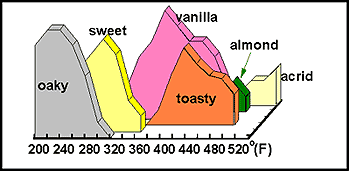
Diagram from http://www.worldcooperage.com
Hexenwolfe writes ..
-
Jack Daniels is 140 proof grain whiskey when it goes into the
barrel. The barrel is made from American white oak from Missouri.
Each barrel is roasted at 450 degrees for four hours then flash
charred over a 1500 degree gas flame for 4 minutes. It is then steam
quenched to "activate" the carbon (and put out the fire!). The
roasting carmelizes the sugar in the wood before the flash burn
creates the charcoal. The steam treatment not only puts out the
fire, but it causes the charcoal to expand like popcorn creating
trillions of tiny bubbles. This GREATLY expands the surface area of
the carbon. A fresh barrel will have approximately 1/3 inch of char
on the inner surface.
Jack Daniels Whiskey is aged in the barrel for four years. During this time the barrels are racked in wooden barns. There is no heating or cooling in the barrel houses. The heating and cooling of the natural weather cycle in central Tennessee causes the whiskey to expand and contract with temperature. As the whiskey expands it is forced into the wood.In the wood it dissolves carmelized sugars, and tannins. As it contacts, it moves out of the wood and back into the barrel. The carmelized sugars give the whiskey it's red-brown color. The whiskey will penetrate approximately 3/4 of the thickness of the barrel stave. The penetration line is easy to see on an old barrel stave. Jack Daniels uses each barrel only once. After the whiskey is removed, the barrel is sold to other whiskey makers, European wine makers, the makers of tobasco sauce, and the public.
After ageing the whiskey is diluted to 80 proof before bottling. To answer your question regarding toasting and charring... They are not the same process. Toasting is baking the wood at 450 to carmelize the sugars. Charring is actually burning the surface of the wood to create charcoal. For hobbiests, it is easier to use toasted chips for flavor, and activated charcoal filtering for clarifying. These two processes are combined into a single stage process in barrel ageing.
Jack advises :
Split the wood into finger- width sticks about 4 to 6 inches long, then pack them into an old coffee can that has no more of that coffee smell or any rust. Pack them in standing upright so there isn't much space between them. Once the can has a solid layer of these sticks crammed in together like sardines standing upright, cover the top of the can with a layer of heavy tinfoil that has a pencil sized hole in the middle of it. Place this arrangement on your propane burner (this is not to be done inside!!), and set the heat on high. After a bit of heating up, some steam, then other various flammable organic gases will evolve off (if the foil swells up, make the hole a bit larger- try not to burn yourself). Once there is no more gas/steam coming out, turn off the heat and let the can sit outside to cool on it's own with a cover to exclude any air from getting in. Once cool, rinse any ash off in some cold water and use however you wish. Do not poke any holes in the coffee can - that will allow air into the mix and turn all of the wood into ashes, instead of turning it into charcoal.
Using a pressure cooker to inject steam could also be attempted to try an make activated carbon, but I haven't tried it.
Jack also writes :
The residual sugars in the charcoal give a slight sweetness to the finished spirit, and the limited absorbing ability of the charcoal only makes the stuff smoother, but doesn't strip all the flavor out. I have tasted homemade whiskey and rum made and filtered in this method, even at "barrel strength" (75%) they were very smooth - no ice was even needed.
For a "Wild Turkey" style flavour, Wal advises ...
1) Aging technique. "Wild Turkey is distilled and put into new barrels at a much lower proof than most Bourbons - a costly method that results in less of the flavor being cooked out. The barrels are made of the finest new oak with the heaviest char available, imparting a smoother flavor and a deep amber color."
2) Taste. "best flavors of our premium bourbon, but with real honey to give it sweetness...." "real honey" "obvious notes of vanilla and citrus" (this could come from the heavily charred American oak barrels). "Wild Turkey Liqueur is a sweetened cordial with honey" - 30%abv.
3) Wild Turkey Liqueur was introduced in 1976 - htp://www.wildturkeybourbon.com/nest/history.pdf (possibly it was introduced to compete with honey based Scottish whisky liqueurs).
It appears to me that a starting point would be to age your raw whiskey distillate in heavily charred American oak chips, and then add a pure honey to say 25% sweetness (start with a 250 ml cup/l). Some orange peel might have been added to imitate Southern Comfort(?) The vanilla would probably come from the American oak which has that characteristic.
The "Household Cyclopedia" recommends ...
You can also use virgin wood shavings - the greater surface area will work faster. Taste regularly to ensure that it doesn't get too wooded, then filter out when ready.
Wood-essence can be made by soaking the shavings or toasted wood in 70% alcohol for a couple of weeks, then strain them off. Another suggestion is to pressure-cook the shavings with neutral spirit for 10 minutes at medium pressure, but this sounds risky!).
Brian writes ...
Jeanette suggests to use the toasted oak by ...
- Line up bottles to be used, add your undiluted spirit, and put in appropriate amount of flavouring. Personally, if it says 10ml per litre, I add 15ml.
- In a stainless steel saucepan, put in amount of water needed to top up one bottle only. Add one tablespoon of toasted oak chips.
- Bring to boil, then immediatly turn heat down and simmer. We don't want to boil off all the aromatics of the oak. At this stage add a large teaspoon of glucose and stir in well.
- Simmer for about 5 minutes, bring to boil again, then take off heat and let cool. The mixture should be a lovely brown colour.
- Strain and add cooled mixture to your bottle of spirit and it is ready to drink. Or don't strain, and keep the flavour coming for an even smoother, flavourful drop in the future.
From Cheryl (Victoria, Canada)...(posted on Distillers newsgroup)
See below about using casks
Where to source the wood chips ? Donald suggests ...
Wal writes ...
The changes in the spirit during wood aging are caused by 3 types of reactions occuring simultaneously and continuously in the barrel.
1)complex wood constituents are extracted by the liquid
2)there is oxidation of components originally present in the liquid as well as of material extracted from the wood
3)there are reactions between various organic substances present in the liquid, leading to the formation of more and new congeners
As with wine, the type of wood is very important and most of the major spirits have strict requirements. Bourbon whiskey regulations require that the barrels be new, and that the insides be charred. This is done by setting the inside of the barrel on fire until a layer of char is developed. Most other whiskies and other spirits do not have to be aged in new, unused wood, nor do the barrels have to be charred. Charring improves and softens the taste of the spirit and provides both body and color.
The manufacturer will decide what specific type of spirit to make and there is a close relationship between distilling and aging strategies.
Anything distilled over 95%abv is legally termed "neutral" spirits.
Bourbon cannot be distilled over 80%abv
Cognac cannot be distilled over 72%abv
Rum is distilled at 85-96%abv
Scotch malt whiskey is distilled at 70-71%abv
Canadian whisky is distilled at 70-90%abv
The congeners, those secondary products produced during alcoholic fermentation, consist of acids, esters, aldehydes, fusel oils, extracts of mineral salts and solids in minute quantities. Collectively, they do not amount to much from a percentage standpoint, but they are determining factors as regards product character.
Esters are volatile substances which give aroma to the spirits Aldehydes are produced from alcohol/air reactions and contribute to the character of the spirit.
Fusel oils are higher alcohols and form complex mixtures. Not all these compounds are desirable, and even those which are, should be present in specific amounts.
Cognac/Brandy
The use of copper stills is important because the contact between copper and liquid traps fatty acids and sulphur elements. Cognac regulations permit French oak only. The barrels are not charred. Freshly distilled cognac is placed in new barrels perhaps for 16-18 months. Barrels are considered new the first 3 times they are used. The first of the 3 will be for only a few months since the wood will impart excessive tannin to the spirit. The second use may be for up to 2 years and the third even longer. The barrels are kept filled unlike bourbon and malt scotch whisky. Blending is a key factor. Both caramel and sugar syrup are legal and regulated additives. An unregulated practice is the use of oak chips soaked in old cognac and left in cask for months or years. The purists regard that the character from this is rather hard and tannic.
Bourbon whiskey
Charred barrel aging is said to impart the characteristic vanilla and caramel flavor of Bourbon. There are 4 grades of char and each distiller has their preference. Charring produces a layer of partially caramelised sugars below the char. Charring imparts color to the spirit and whiskey stored in new, charred white oak develops the distinctive red-amber color. Additives are not permitted. The used barrels are sold to distilleries in Ireland and Scotland.
Scotch malt whisky and Irish whiskey
Most malt whisky is matured in Bourbon barrels, only 4% is in sherry barrels. One difference between American oak and Spanish oak is that the American species is harder and consequently matures whisky more slowly. Spanish oak contains more resin which effects the flavor. Sherry and bourbon leach out the stronger tannins and oak extracts, creating a lighter product.
Rum
Maturing is done is used in previously used barrels which may or may not have been charred. Puerto Rican law requires a minimum of 1 year in wood. Fuller and more distinctive rums result from increased wood aging of a minimum of 3 years. Caramel is used to adjust the color. The typical dark color of Jamaican rums is due to the caramel added. The coloring is produced by heating sugar solutuins to about 82C (180F) to evaporate the water and caramelize the sugars.
Wal then asks ...
- Water
To cut excessive alcohol. But vintage cognacs/armagnacs achieve their 40%abv by slow evaporation (3% a year), so dilution has an effect on flavor and for traditionalists reduction is a bad word. For homedistillers a lower %abv distillation will contain more flavor compounds. - Boise (e is accented)
A boise essence is made by boiling chips in water and then removing the chips and slowly reducing the remaining liquid. What one is left with is a dark brown liquid that is replete with wood flavor and tannin. Another source mentions infusing shavings in cognac. Charred French oak chips are also available which act like charred white Ameican oak chips - more caramelised sugars and vanillin i.e. softer flavors. - Sugar Syrup
Used to add sweetness. Normally added if a cognac/armagnac is too tannic, or to remove any rough edges. It is viscous, and can either be dark or light. Legally 2% can be sugar syrup. 1 tsp/1 litre(quart) is a good starting point. - Caramel
A liquid from burnt sugar. It is dark in color and slightly bitter in taste. It is used to adjust color and establish consistency or give the spirit the impression of being older and therefore smoother.
American whiskey can gets flavors only from the charring of American white oak staves. American white oak contains less tannins and more vanillin than French oak. Filtering through maple charcoal is also practiced, and this has an effect on flavor due to caramelised sugars in the maple charcoal. A Bourbon essence could possibly be made by soaking charred American oak chips in Bourbon.
Rum is aged generally in used Bourbon barrels. Reusing the chips from making a Bourbon essence and soaking in aged rum (in effect diluting the wood character) would emulate a used Bourbon barrel.
Scotch and Irish whiskies are aged by reusing Bourbon or Spanish sherry barrels. Irish whisky is usually triple distilled (90%abv) as opposed to the double distilled peated malt Scotch whisky. So the amount of distilled congeners is different in the two styles. An essence could be made by soaking in aged whisky for a second time, American oak chips that were soaked previously in Bourbon, or European oak chips previously soaked in Spanish dry oloroso sherry.
The use of sugar and caramel is practiced in all the above liquors except Bourbon and Tennessee whiskies, and a starting quantity to achieve smoothness would be 1 tsp/litre. The amount of caramel (burnt sugar) used would depend on the style required.
Casks
Some wine-making shops sell little oak casks. These really do work well. Leave your finished liqueur in these for a while, and they mellow out even more.See http://www.ibrew.com.au for a selection of the small casks available in Australia.
If you leave the bung-hole of the cask (once filled) open for several days, it is said to improve the flavour. Donald disputes this ...
The truth is, we don't need any drunken angels! More to the point, the process of evaporation is distinct from the process of oxidation. Although they are often confused and used interchangeably. The whiskey flavour can be achieved with out any evaporation at all, because the flavour component comes from oxidation process alone. The alcohol solubilizes the lignins of the oak which then oxidize into vanillins. Usuing oak chips with an air tight container (stainless steel or glass) with a 1/3 to 1/4 air space at the top, so 100% evaporation is recaptured with 100% oxidation. This also eliminates the risk of a sour barrel, just like a screw cap prevents rotten cork spoilage (3%-4% average).
To price out full sized barrels for yourself, see
- http://www.1000oaksbarrel.com/oakbarrel.html
- Lehmans Catalog, or
- World Cooperage,or
- http://www.lindsaybks.com has a
book "The Cooper and His Trade" for $18.95 US and it is book number 482.
See http://brewery.org/brewery/library/LmbicJL0696.html#Oak for more information about oak casks. Its written regarding using them for brewing Lambic beers, but there's heaps of info that's still pertinent.
Kristofer D offers the following advice :
Mike P writes :
An old codger from down the road told me if I added a few (6-10) black peppercorns to my aging process I would get a new appreciation! I did and it worked very well, there was no taste whatso ever from the peppercorns but you got that warm feeling inside right away after drinking it! It was a nice touch. I have used it often since then with very pleasing results, careful though and don't fall into the same trap I did, if 10 was good, then 20 must be better and a 100 would be better yet!!! Ohhhhhh... the heartburn!!! :-)
How do casks work to mature the spirit ? Its a matter of the wood letting in a little oxygen, and letting out different proportions of the alcohols and cogeners present, as well as reacting with some of the ligins & other substance of the wood. An email from Jim Busch, to the HBD, offers:
In whiskey maturation one of the key reactions involves diffusion of products from within the cask, through the cask wall. Basically its called a subtractive reaction in this case. The key parameters that pass through the cask are water and ethanol. The lower the molecular weight of the compound the easier it is to evaporate through the cask. This means that it is much easier to reduce the concentration of ethanol in a cask than it is to reduce fusel alcohols, as the latter are longer carbon chained alcohols. This route is also the main factor in DMS reduction in whiskeys. Hasuo and Yoshizawa, '86, found that the rate of evaporation of a model whiskey ranged from 32% of the total present in the spirit for acetylaldehyde to 5% for isoamyl alcohols to 1% for ethyl hexanoate and acetic acid. So the permeability per compound is quite different. The texts seem to indicate that in whiskey maturation there is a net concentration of fusel alcohols and esters of fatty acids. Similar results apply to cognac production where Ive seen a reference that indicates a typical loss of 3% per year in both water and ethanol and a concentration of fusel alcohols.
The chemistry of spirit maturation in casks is quite involved and interesting. The key reactions are extractions from the cask, chemical reactions and oxidative reactions inside the vessal (which continue as the flavanols, tannins, hemicelloses and lignins leach) and concentration reactions.
Arthur Bell, at http://claymore.wisemagic.com (dead link ?) says ..
Within the Scotch whisky COOPERAGE two distinctive types of white oak are employed to fashion barrens from America or from Spain. The AMERICAN oak (Quercus ALBA) contains less than half of the total wood extract found in the EUROPEAN oak (Quercus ROBUR). The Bourbon Whiskey industry uses solely American oak suitably charred to promote the carmelisation of the wood sugars, so essential to bourbon character. This pre-treatment of the American barrels with fire and spirit has become acceptable to the Scotch distiller. The alternative and much sought after source of pre used cask is JEREZ Spain which offers both American and European oak casks having previously contained SHERRY wines.
It will be appreciated, as with all things in life, the expected enhancement of spirit quality within the cask does not always materialize and those SULLIED barrels are discarded, no matter how slight the imperfection. A similarity exist between CORKS in wine or whisky and wood for casks, that the SOURISH MUSTY - DANK flavours of bad wood spoils the barrel content.
Charlie Maclean, writing "The Language of Whisky Tasting" at the Scotch Malt Whisky Society offers ..
He writes: "Single malt whiskies are chemically complex and are known to contain several hundreds of individual components (congeners) including a variety of alcohols, aldehydes, acids, esters and phenols, as well as carbonyl-, sulphur- and nitrogen-containing compounds. Many of these contribute to the flavour of a whisky and the relative concentrations of each are dependent upon variations in raw materials and production methods. Consequently, each single malt whisky is discernable from any other, including those produced at a neighbouring distillery."
The investigation, which is continuing, began by identifying the relative concentrations of compounds known to be extracted from the cask during maturation ('cask-extractive congeners') and a group of those which arise from the raw materials and during production ('volatile phenolic congeners'). It went on to make a correlation between these and the perceived flavour of the finished product.
Four samples of whisky were considered, affording a regional spread. They were: Caol Ila (Islay), Scapa (Orkney), Rosebank (Lowland) and Balvenie (Speyside). "Cask-extractive congeners are of great importance to the overall flavour as well as the aroma and colour of the finished beverage.
Whisky casks are traditionally treated to thermally degrade the internal surface of the cask, by firing and charring, for three major reasons:
- to generate a layer of active carbon which removes undesirable flavour substances;
- to effect the release and dissolution of flavour compounds such as vanillin during maturation;
- to yeild colour and phenolic substances which result in new flavour compounds by oxidative interactive reactions.
"Volatile phenolic congeners' primary source is from the peated malt used in whisky production. So it was not surprising to discover that the Caol Ila sample had a large number present and in concentrations greatly in excess of the other whiskies under investigation. "The presence of phenol at 2.1 parts per million (ppm), was almost five times that for Rosebank, 20 times that for Balvenie and 200 times greater than that found in Scapa. Phenol has a medicinal taste and therefore would be expected to be present in an Islay whisky. Guaiacol, known for its smoky and phenolic flavour, was detected in concentrations of 1.2 ppm in Caol Ila, but was barely detectable in the others. Further investigation showed that the levels of compounds responsible for 'tarry' and 'disinfectant' flavours (m-, p- and o-cresol) were evident in the Islay sample but rela tively low in Rosebank, very low in Balvenie and not detectable in Scapa. However, similar concentrations of the compound eugenol (perceived as having a flavour not dissimilar to that of cloves) were determined in both Scapa and Caol Ila. All of the whiskies investigated contained varying concentrations of 4-ethyl phenol and 2,5-xylenol, which co-eluted and could not be determined separately. Both of these substances have a powerful 'whisky' flavour."
Mr Brown concludes: "Many other compounds were determined analytically during this investigation, however their individual impact on flavour is considered less important than their contribution to the overall flavour of each whisky. These analyses are intended to give an insight into the complex chemistry of single malt whiskies and the impact which each of the many hundreds of compounds has on the characteristics of the finished product."
Charlie Maclean
Another article, "Whisky Dectectives" at the Scotch Malt Whisky Society describes how different techniques for drying the wood affects how well the spirits mature.
Yue Hung has forwarded some information from an article "The Production and Aging Of Wine in Small Oak Cooperage" published in the May 1969 edition of "Wine & Vines¨ ...
The mechanisms and processes which occur during the aging of wine in the barrel can be grouped roughly into three closely inter-related categories. viz. physical, physico-chemical, and biochemical.
Physical. The most important physical aspect of cooperage in the aging of wine is its size, because the surface-to-volume ratio affects the rapidity with which certain processes take place and the degree to which they influence the character of the wine. Since all of the aging mechanisms are influenced to a different degree by variations in barrel size, it follows that there must be one single optimum size, one ideal surface-to- volume ratio which establishes the best balance of the wine and which most perfectly favors and develops the character of the wine during aging. We are, fortunately, the beneficiaries of centuries of experience in this area, and we can state with some certainty that, in the great wine regions of France, at least, the barrel size of 225 to 230 liters (about 60 U.S. gallons or 50 Imperial gallons) has proven to be the most perfect. We have little reson to double that this size, or a size reasonably close to it, will produce the same good results in other areas. Indeed many of the best wines of California and Australia (to give two examples ) have been produced and/or aged in this size cooperage. Similarly, the optimum barrel size for Cognacs and fine brandies has been established to be 300 liters (about U.S.gallons or 66 Imperial gallons) It should be emphasized that half-quarter-eighth- etc.. size barrel are made for the purpose of storing odd amounts of wine or for breaking down a full barrel when topping.(Not that wine cant be successfully aged in these small sizes, its simply that the results are not quite so satisfactory, and that much greater care must be taken, through more frequent organoleptic examination, to avoid an imbalance in the finished product)
The most obvious physical process which occurs during aging is the slow imbibition some of the liquid by the wood and the subsequent evaporation into the surrounding atmosphere .There are five prince influences in this process : relative humidity, temperature, air movements in the area where the barrels are kept, the physical characteristics of the wood, and finally, the frequency of topping. This last is important because, where the topping is less frequent there is more opportunity for an area of wood to become dry and thus slightly more porous due to shrinkage of the wood tissue The important of the first three items first emphasized by Pasteur,has been forcefully demonstrated by Riberean-gayon(3) whose experiments with 60 gallon oak barrels gave the following results: in good oak barrels which are cold and humid, the evaporation lose can be kept to 1 or 2 per cent; in ordinary wineryies it is 4 or 5 percent;and in poorly designed wineries which are too warm,too dry,and/ or too much expose to air currents, the loss can be as high as 9 per cent. The evaporation loss is also greatly influence by the type and thickness of the wood..
Ian Wisniewski (whisky and spirits writer, and author of Classic Malt Whisky (Prion Books)) wrote about Oak at Whisky World (big thanks to Whisky World for letting me copy these extracts !)
-
While oak ageing is an historic tradition, wood management is a far more recent discipline. The benefits of oak ageing have long been appreciated, rather than understood, but its only since the 1970s /80s that technical knowledge has supplanted anecdotal theories. With the continual advance of analytical techniques revealing the extent of oaks influence during maturation, the growing focus on malts, as well as longer maturation terms, wood management has become key.
The archetypal maturation mandate is to reach a balance between the beneficial characteristics gained from the oak, while also retaining and developing the individual distillery character embodied in new make spirit. As oak ageing can account for up to 60 to 70% of a malts eventual flavour, or around 40% in the case of heavy peating, its a variable balancing act.
Because different malts have varying ageing potential, longer maturation does not guarantee a finer malt. Its a case of variations on a theme: yielding different expressions at different ages, as the oak influence intensifies. Moreover, the appeal of a malt may be a case of less is more, or more is more. The right age depends on your own palate.
Younger whiskies can have great enthusiasm, then after about 10 years you start to get a real mellowing out and balance; for me the balance is complete within 15 to 20 years, says Jim McEwan, Bruichladdichs malt maestro. At 20 years the oak starts to really exert its influence, and at 25 years has a different, really good character, being mellower, rounder, slightly drier, and the heat drops into the chest, not the palate. Between 25 to 30 years the oak, and where the malt is matured, start to play a very important role. Thirty years and onwards there is a huge concentration of oak in the spirit.
Maturation can be divided into three essential elements. Subtractive maturation, like a rites of passage for the ingenu new make spirit, entails the loss of immaturity. Additive maturation sees the oak endowing the spirit with colour, aromas and flavours, while interactive maturation refers to reactions between the spirit and the oak. This is something of a mystical union that is not fully understood, yielding an additional range of characteristics that neither the spirit or oak possess individually.
It would be very convenient if subtractive, additive and interactive maturation followed each other in an ordered, chronological sequence. However, these separate elements effectively occur simultaneously throughout maturation, albeit at differing rates.
Oak-derived flavours, for example, can be evident within the spirit from around six months, though losing immaturity may take a couple of years, or even extend over several. Similarly, filling a barrel with spirit can be said to initiate a form of interactive maturation. This reflects the fact that 2 to 3% of the new make spirit is drunk in by the staves, possibly even within 48 hours, and subsequently begins to mingle with the wood extractive liquid of the casks previous contents (although the full effect will, of course, take years to complete). In fact, specific flavours can be attributed to interactive maturation, due for example to the formation of esters.
While The Macallans citrus and floral notes originate from the new make spirit, the dried fruit notes derive from esters that have been created during interaction with the cask, and also from oxidisation, says David Robertson, The Macallans Master Distiller. An initial consideration is the difference between using bourbon barrels, fashioned from American oak, and sherry casks, which are usually produced from European oak, though American oak casks can also be seen in action at sherry bodegas.
European oak, typically harvested from 60 to 150-year-old trees, comprises a looser, more open and porous grain than American oak. This enables the spirit to penetrate the oak more readily than American oak, usually harvested from 40 to 100-year-old trees, which comprises a straighter, tighter grain. The level of tannins, promoting astringency, balance and structure, is also far higher in European oak than in American oak. However, charring bourbon barrels on the inside, while sherry casks are merely toasted, makes the interior of a bourbon barrel more accessible to the spirit.
These technical differences also promote a varying range of characteristics. In terms of colour co-ordination, sherry casks lend an orangey, amber hue, which is distinct from the lighter, golden, straw tint of bourbon barrels. The flavour profile also varies significantly with sherry casks contributing rich fruit (such as raisins, prunes, dates, figs, apricots), fruitcake, fortified wine, almond and walnut notes, spices such as nutmeg, ginger and cloves, not to mention creme caramel, chocolate, and a (positive) sulphurous note, delivered within a rich sweetness.
Bourbon barrels lend a lighter, drier sweetness, with a palate thriving on a medley of flavours: vanilla, honey, various fruits, almonds, hazelnuts, coconut, creme brulee, sherbet, spices such as cinnamon, as well as mint and eucalyptus notes.
The influence of bourbon barrels can be further sub-divided according to the degree of charring. The scale ranges from one to four, beginning with a burnt toast effect, and culminating in an alligator char, the popular term for a number four, as the surface resembles alligator hide. Various malt distilleries have an inventory of bourbon barrels with a range of char levels, with a heavier char typically giving greater amounts of vanilla, creme caramel, toastiness and hint of smoke, not to mention more intense colour. Alternatively, a milder char promotes greater sweetness, honey and vanilla, while also endowing the spirit with more body.
The fill (referring to the number of times the cask has been filled with spirit) is another important consideration, with many distillers using a recipe of different fills to help achieve consistency, or a particular flavour profile. Each fill of a cask results in its degree of influence on the spirit diminishing, until the Master Distiller deems it to be exhausted. If a first-fill cask is said to contribute 100% of its available characteristics, a second-fill will contribute around 60%, with a third-fill (when relevant) dropping to around 35%. Consequently, a second- and third-fill require a longer time-frame than a first-fill to complete subtractive maturation. For example, spirit maturing in a second- or third-fill could require about 10 and 15 years respectively, in order to reach the same degree of maturity as a spirit aged for seven to eight years in a first-fill cask.
However, this does not mean that each successive fill also delivers the same flavour profile, in a progressively milder format. Its actually a case of obtaining varying, rather than subtler flavours from different fills. Then again, its also a case of imparting an appropriate influence to the particular house style of the spirit. A lighter, unpeated malt, for example, may principally be aged in second-fill sherry casks, to ensure that the oak influence doesnt predominate.
The first-fill of Spanish oak sherry casks gives a dark mahogany whisky, with rich, woody spices such as cloves and ginger, toffee sweetness and dried fruits, says David Robertson. When refilled there is a less robust oak influence and more new-make spirity character coming through, together with more apples, esters and floral notes, while the tannins manifest themselves as light spices (such as cinnamon) rather than oak.
Similarly, a first-fill bourbon barrel offers a different influence to products further down the line. A first-fill bourbon barrel has more natural sweetness and body, the second-fill allows more products of oxidation to shine through and gives more of a floral top note, though greater oxidation also reflects the damper ageing conditions of a traditional warehouse, says Dr Bill Lumsden, Glenmorangies Head of Distilleries and Maturation.
Spirit within a first-fill bourbon barrel also has optimum contact with the charred layer, though the chars active influence does diminish during maturation, not to mention physically breaking down within the cask. (Consequently, when the spirit is emptied after the first-fill, some charcoal also leaves the barrel, reducing the level of char available during the second-fill, which is also less active anyway). This gives a lower level of vanilla and burnt heather notes which stem from the char, while simultaneously increasing the level of oak influence. Another principal difference between successive fills is the level of wood extractive liquid remaining within the staves of the cask. Not simply a case of residue bourbon or sherry, this liquid also incorporates additional wood-derived compounds, which could total around 75 cl in a 200-litre bourbon barrel, or 10 litres in a 500-litre sherry butt.
The largest amount of wood extractive liquid is present within a first-fill, and released during the first few years, with some wood extractive liquid remaining in the second, but only a minimal amount is released from a third-fill. Traditionally this residue was considered an important element, though the nature of the oak, European or American, is now established as the primary influence during maturation, and the wood extractive liquid a supplementary influence.
Jack Daniels Whisky
See Jacks instructions on the Preparing Grain Mashes page for the grain bill, and his comments in Aging re passing it through maple charcoal.Johnnie Walker Whisky
Les suggests ...- 1 sachet 40gms Classic Greenlabel Whisky.
- 2.5 litres 44% alcohol .
- 100 mls Glycerine
- 2 teaspoons Eazimix spirit finisher
- 6 teaspoons Virgin American Oak shavings
- 150 mls medium dry sherry (good quality)
Bourbon
Bill recommends the following for a Bourbon made from essences ...- Soak 2.25 litres 40% in 1 bag of JD's chips and 50 mls of flavour from Classic American Bourbon Sachet and age for 3 weeks
- Soak spent JD' chips ( from above) in 1.125 litres of 40 % and flavour with 15ml of Sprits Unlimited premium bourbon mix Allow this to soak for 3 weeks
- Soak 1.125 litres of 40% in 1 heaped Tablespoon of virgin oak sawdust, add 1/2 a sachet of Classic Tennessee Flavouring and allow to soak for 3 weeks
- Combine in the same ratio
- 2 x 1125mls on chips and American Bourbon
- 1 x 1125mls on spent chips and premium bourbon
- 1 x 1125mls on oak and Tennessee flavouring
- Age for another 4 weeks
I find the best thing is to put down a couple of litres a week. Once the ball is rolling you will have a steady supply of quality Bourbon.
By the way, this recipe took 18 months of weekly brewing flavouring and tasting to perfect. Call it a labour of love.
Allowing for a clean starting spirit this will give you a Bourbon that is best served on its own with just a dash of water to bring out the flavour.
Mecakyrios writes ...
Smudge describes his technique ...
The process is fairly simple – get whatever you want as flavouring, soak it in alcohol, and distil it.
For the sake of consistency, I use 500mls of base material (corn, rye, barley etc) and 2.5 litres of 40% alcohol. It sits for a week, and then I add water to make 4.5 litres and distil it.
OK, for the purists out there, I admit it's not the real thing, but its getting close. And it's better than anything I have ever tasted that wasn't from a bottle shop.
I did some research on bourbon to work out where its characteristic flavours come from:
It is primarily made from corn, but rye is used to give it body. Much of the flavour, however, is obtained from the barrel. Unlike whisky, bourbon is aged in virgin oak. Bourbon barrels are charred with an intense flame, which caramelises the sap producing the characteristic vanilla/caramel flavour.
I set about combining corn, rye, oak, vanilla, caramel and smoke. Here's what I came up with:
I distilled separate batches of corn and rye as detailed above and watered each back to 40%.
I have some 60% alcohol that has been in a 15litre barrel with 2kg of toasted oak staves. It is black as night and has the warm smell of dark rum. I distilled some of it (1.6litres at 60% watered back to 4.5litres volume) to produce a clear liquid with an oak flavour.
I distilled 50ml of liquid smoke (purchased from the supermarket) in the same alcohol/water proportion as above.
I added 50ml of concentrated vanilla extract (the expensive stuff) with 40% alcohol to make a total volume of 500mls.
I caramelised 1 cup of sugar (on the stove) to a rich red/brown colour and diluted it back with 60% alcohol to a volume of 500mls.
I diluted a bottle of Spirits Unlimited Bourbon to 500mls with 40% alcohol. Don't substitute the Premium Bourbon, as it doesn't have the same perfume taste.
I combined the ingredients in the following ratio:
| Corn | 600 mls |
| Rye | 300 mls |
| Oak | 150 mls |
| Caramel | 80 mls |
| Vanilla | 60 mls |
| Smoke | 30 mls |
| S/U Bourbon | 30 mls |
The result is quite pale, but it lets you barrel age it without it getting to dark. It can also be darkened with some concentrated (un- distilled) oaked alcohol.
It involves some effort but the cost of the flavouring is low at about AUD$1 per litre of spirits.
Rum
Ed of http://www.MinistryOfRum.com writes ..Sherry is commonly used as an additive in the rum industry although most distillers won't admit it. For best results, blend the sherry and then dilute the spirit to drinking strength before aging.
In the US, only new barrels are used for aging whisky and they can only be used once. A lot of these once-used barrels end up in the Caribbean at the rum distilleries, aging rum. The rest end up at hardware stores and are sold as planters.
A lecture on "Processing of Jamaican sugar cane" by Robert Lancashire yields ..
The Jamaican Excise Duty Law, No 73 of 1941 defined rum as "spirits distilled solely from sugar cane juice, sugar cane molasses, or the refuse of the sugar cane, at a strength not exceeding 150% proof spirit".
Rum is produced from sugar cane by fermentation by yeast. The resultant "wash" has approximately 6% alcohol which after distillation produces rum as a clear, colourless liquid with about 80% alcohol and a sharp taste. White rum is essentially this product diluted to 40% alcohol. Gold rum requires aging in small (40 gallon) oak barrels. The process of aging is very complex, involving evaporation of some of the pungent volatile components, reaction of the rum with the oak wood and perhaps even the absorption of oxygen through the barrel to convert some of the alcohol to aromatic esters.
The total level of flavour components rarely exceeds 1% of the total weight (and is normally much lower) in a base of ethanol. This high concentration of ethanol presents particular problems in both sensory and analytical studies. Furthermore, the advent of gas chromatography has shown that most of the components found in potable spirits are the same and that the nuances of flavour are essentially attributable to small differences in the relative proportions of these components.
Note however that expert tasters have been known to name the district and frequently the actual estate from which the rum originated, just by the sense of taste and flavour.
In Jamaica, gold rum is generally bottled at proof strength
(Imperial) which is 57 Volume % alcohol. (By comparison, 100 US
proof is 50 Volume % alcohol).
The following figures were found for a light-bodied rum that had been aged in charred oak barrels (previously used for aging bourbon).
| Composition of Rum and American Bourbon Whiskey | ||||
|---|---|---|---|---|
| Jamaican Rum | American Bourbon | |||
| Age (years) | 0 | 3 | 0 | 3 |
| Constituents | Concentration g/100L | Concentration g/100L | ||
| % alcohol | 80.1 | 78.2 | 77.5 | 75.5 |
| total solids (extract) | 0 | 87.6 | 0 | 136 |
| fixed acids | 0.9 | 8.8 | 0 | 12 |
| volatile acids | 1.1 | 20.9 | 3.2 | 50 |
| Total acids | 2.0 (pH=4.9) | 29.7 (pH=4.5) | (3.2) | (62) |
| esters (for years, erroneously called ethers) | 9.7 | 37.5 | 9.6 | 42.0 |
| aldehydes | 1.9 | 4.7 | 0.6 | 5.6 |
| fusel oils (higher alcohols) | 48 | 66 | 250 | 298 |
| furfural | n/d | 1.6 | 0.12 | 1.42 |
| tannins | n/d | 33.0 | 0 | 62 |
n/d= not detected