
| Summary |
|
Soaking neutral alcohol with activated carbon for a week
(or even months) will help remove some of the off-flavours -
this is known as "polishing" the spirit. The spirit should be diluted to 30-50% before polishing. Don't polish spirits that you want to keep the flavour of (eg whisky or schnapps). |
If you are making NEUTRAL alcohol, make sure it is polished using activated carbon or better (see below). Soak it for at least a week (and up to a couple of months) to remove any aldehydes, aminos and fusil oils that could be present. I use about 1 cup of carbon to 4-5L of spirit. This will take out the rough edge usually associated with typical moonshine, and leave vodka's clean, tasteless & odourless, ready for flavouring.
If you DON'T want vodka, then DON'T use carbon.
The carbon works by being a type of "molecular seive", trapping the molecules which are larger than ethanol. They become trapped in the pores inside the carbon, and also by surface energies on the carbon. So it won't remove methanol, but only larger molecules (eg the fusels). Likewise, the trapped molecules are sometimes held fairly loosely to it, so if you try to filter too fast, they can be washed off the carbon and back into your spirits.
Make sure that you always pass your polished spirit through a paper filter. Many of the impurities are held by very fine carbon dust - and will still affect the flavour. If you pass even crystal clear polished spirit through a paper filter, you will notice that it becomes grey or black. You'll notice the cleaner flavour too. It doesnt take much - just a littl bit of tissue paper or cotton wool in the bottom of a filter, and you'l trap that loaded dust.
If you're looking to buy carbon, see Brewhaus.
Grant writes ...
- activated carbon acts in three ways:
Adsorption - relying on electrostatic Van der Walls forces. This attractive "force" forms relatively weak bonds between the carbon and adsorbate. In theory activated carbon could release or desorb what it removed at some point, but from practical experience desorption rarely occurs.
Absorption - refers to the diffusion of a gas or compound into the porous network where a chemical reaction or physical entrapment take place. Ozone for example is absorbed into activated carbon where it oxidizes a portion of the carbon's surface. Ozone (O3) is reduced to oxygen (O2) thus "detoxified". Ozone does not accumulate or build-up in the carbon structure.
Chemisorption - an irreversible chemical bond between the carbon surface and the adsorbate. Pollutants are tightly bound to the sorbent.
The filtering of alcohol primarily involves the removal of organics via adsorption. After the activated carbon has reached exhaustion and all the adsorptive sites are filled, it can be regenerated. Chemisorption is associated with the removal of inorganic chemicals and the carbon used to remove these compounds is generally not regenerated.
-
Adsorption is primarily an electrostatic phenomenon and chemical bonds play no part in it. The porous nature of the carbon is induced in order to increase the surface area available, a typical value often quoted (and true) is approximately one football field area per cubic centimeter of carbon. This process of inducing porosity is what is meant by the term "activation". Geometry also plays a part in this, enhancing the weak electrostatic attraction for certain sizes and shapes of molecules in a manner similar to that used by enzymes which have shaped "pockets". In this manner, materials can be processed to selectively adsorb some molecules better than others, as in respirators. Carbon that has not been treated in this way will still adsorb molecules but, for practical purposes, the effect will be insignificant if the surface area has not been increased. Adsorbed molecules held on the surfaces both inside and outside of the carbon may be released by heat and subsequent vaporisation. Please do not confuse rinsing new carbon to get rid of salts etc before initial use with heating after use to release adsorbed molecules.
Specifically, we are interested in removing compounds that have taste or odor and which, like those that contribute color, tend to bind strongly. With these, the only bonding is by weak Van der Waals forces. There is no significant redistribution of electron density in either the molecule or at the substrate surface, and subsequent release of the molecules by heating is easy. Heating in an oven to 160 deg C is quite sufficient to clean used carbon to the extent that it can be used again, particularly when the carbon is first soaked in water to provide active flushing with steam as it boils. Of course, this will not release all the adsorbed molecules heating to a much higher temperature in an inert atmosphere is needed to do that thoroughly but 90+% efficiency is good enough for all practical purposes, and has been used as a cost-effective recovery process by sugar refineries ever since 'white' sugar was processed.
Wet activated carbon primarily removes oxygen from air, not nitrogen. Thus, an asphyxiation hazard exists inside enclosed spaces containing wet activated carbon. Dry activated carbon requires no special precautions. Rinsing activated carbon before first use is a sensible procedure as many carbons, particularly the 'stone' carbons, are produced using chemical etchants which may still linger in the final product (eg. zinc chloride and phosphoric acid). Those are the impurities you want to remove before letting newly procured carbon anywhere near liquids that you are later going to drink.
I've found, however, that it does pay to filter even when the liquid seems crystal clear. Microscopic particles of carbon dust don't settle out, and they are chock full of congeners. Used to worry me that my carbon wasn't working properly until I tried filtering what seemed to be "pure" stuff. The flavour/smell improved immediately and the residue on the filter paper confirmed the presence of that suspended carbon. BTW, I don't bother with expensive filters ... just take a couple of feet of toilet paper and roll it up into a cigar. This gives me a tube of filtering paper that I can cut into whatever lengths I like (usually two) and then gently push into the neck of a large funnel. The harder I push, the finer the filter. Works a treat!
If you are trying to make a flavoured spirit, eg whiskey, grappa, etc DO NOT polish it, because you will remove the flavour that you have worked so hard for.
Don't add any essences or flavouring until AFTER you have polished the spirit. If you add them beforehand, the carbon will adsorb a minor amount of the flavour compounds and aromatics from the essence.
Do not try to reuse your carbons as they are - they are loaded with all the crap that you don't want. You'll need to clean them (see below) before you reuse them.
Another trick is to add some activated carbon to the wash (eg with the sugar) for during the fermentation period. This will take out the cogeners as they form. Just make sure that you filter/decant off this carbon with the yeast, so that it doesnt go into the still (and release the nasties when heated). Its a good way of reusing older carbon that has been used & washed several times, and may be losing its effectivness.
To avoid having the "rough moonshine edge" or "off-taste / wet cardboard smell" in your spirit to start with, don't collect them. These impurities will be present more when using a pot still, less if using a reflux still, and just about absent if using a fractionating column. So one way is to use a taller packed column and increase the amount of reflux occuring. They can also indicate that you've tried to collect too much of the alcohol, and have run into the "tails"; so finish collecting a little bit earlier next time.
Checking for Fusels
Jack recommends a simple (no chemicals needed) test to check for the presence of fusels :-
I came across this "test" to see if spirits contain a large amount of
heads/tails. It requires no chemicals (mention permanganate salts in
California and everyone thinks your running a drug lab or something), and no
skill. Heres how:
- Take a glass that you would normally drink out of and rinse it heavily with water- there should be no soap residue. Then dry the cup with a clean towel (to prevent mineral salts from being left behind after the water evaporates).
- Pour in a little of the spirit you are testing, and swirl the glass around until the spirit has totally coated the inside of the glass.
- Once there is a thin "film" of alcohol covering the inside of the glass- pour out the excess alcohol (drink it), and leave the glass somewhere where it won't be broken.
- The next morning, smell the glass -
- If there is a nice perfumed aroma (for aged or other flavored spirits) or absolutely nothing (for vodka), congratulations- you've made good booze.
- If there is any brackish, sour, solvent-like, or wet cardboard flavors- shame on you- you got greedy and ended up with heads or tails in your spirit.
Dilute the Alcohol
Make sure that your alcohol is diluted to 30%-50% before polishing it - the carbons will work more effectively. This would appear to be due to a number of reasons;- the fusels dissolve better in high grade alcohol and less so if the alcohol is lower in percentage. If the alcohol is diluted, and the fusels are less dissolved, they are then more easily captured.
- carbon/alcohol affinity channels better at these %concentrations, allowing more exposure to interface (ie a greater specific gravity differential, i.e. the "thicker" the better)
- at the diluted ratio the "nasties" are also diluted [does that make them easier to catch ????]
- always use clean water to dilute as this lessens the load on the carbon
- high % alcohol could act as an aggressor to the carbon and cause "nasties" to be leached out the wrong way, eg carbon to alcohol
Types of Carbon
For heaps of information about Carbon, and how it works, go to the Norit site and read the section under Tech Info titled Introduction to the Porous Structure of Activated CarbonThere is also a free ebook about activated carbon at http://www.home-distillation.com/free_ebook.html
Reactivity of carbon is measured using iodine. If you can't purchase the spirit specific carbons, you may have to look around a bit for an alternative. You can see below that Charcoal is fairly useless; try to see what you can get by way of water filters etc.
- Filter carbon : 1050 mg/g iodine absorption
- Treatment carbon : 750
- Contact Reactive carbon : 750
- Charcoal : 45
- Reactivated carbon : 90
If you can't source any highly reactive carbon, but want to make your own charcoal, see How to Make Charcoal at Home by Dan Gill.
If you can't find activated carbon in your local brew shop ...
- Jan recommends .. Activated carbon suppliers in Australia. The best one is in Brisbane called: GOLDCARB. 64 GARDINER ROAD. WATERFORD. QLD.4133 FAX.07-3807-8288 Phone.0418-725 783.Several grades are available and all the carbon he sells is top quality. He is a manufacturer overseas and imports it into Australia. I highly recommend him. Price depends on quantity
- David suggests for the US ... Check out "Calgon Carbon Corporation"
- Kev offers ... http://www.greatexpectations.co.nz/ ship internationally
- In the UK try http://www.chemvironcarbon.com and http://www.activated-carbon.com/index.html These are the big importers of Activated Carbon in the UK, most comes from China. You can purchase small quanitys for "pre-filtering of water for Beer and Wine making", water distilling, esential oil making, etc., etc. A phone call could not hurt. Patrick.
- Randy adds.. Activated Carbon is also used in the filtration of water for minicipal drinking water systems. They use the name anthracite. This is a food grade product. It also is sold in various granual sizes. http://www.activated-carbon.com is an example. I didnt see that they sold via the webpage. For convienience, Gert Strand or one of his authorized local distributers is a much easier (and possibly safer) solution. http://www.brewhaus.com in Canada supplies Gert Strand products here in North America.
- Patrick ..I decided to look at US suppliers of Activated Carbon and found a few. Most say they supply the same quality carbon in 55lb bags for $1.00 a lb US! One company in particular has it for .85 cents lb. in 55lb bags. http://www.generalcarbon.com/liquid03.htm
-
I don't know whether anyone knows this or not but you know those gas
canisters used for fumes and gases on full and half face mask respirators? I
get the expired ones from work, which are only thrown out anyway, because
they contain activated carbon of very high quality and filtering capability.
They are also very conveniently packaged in airtight sealed bags so keep
indefinitely until you are ready to use them. They may be past their safe
'Use by Date' for breathing through a respirator but for what we use them
for I'm sure they have years galore ahead of them. I'd be careful when using
specialised gas canisters though as I don't know for sure if they include
additives in canisters for acidic, alkaline or ammonia rich environments. A,
B or E canisters should be fine though.
-
I have discovered yet another cause of liquor "turning cloudly." In my
case it always happened when I cut it down to drinkable strength of about 80
proof . It didn't matter what temp I distilled at, it would always happen,
leading me to believe that fusel oils were not the cause. This problem had me
puzzled for quite sometime, but I was always able to clean it up with
activated charcoal so I didn't worry with it to much. Just the other day I
discovered it was the plastic tubing I use to connect the still head to the
condenser! apparently the plastic is slightly soluble in alcohol and it comes
out of solution only when water is added. Plastic is no good for stills!
How does the carbon work ? Mike's simple summary ...
-
First thing, some substances have the ability to attract and hang on to certain molecules by electrostatic attraction. Forget all the buzz words like Van der Waals forces, London forces, etc ... they all come down to essentially the same thing as a charged comb attracting bit of paper, the only difference being the distance the attraction works over. Carbon is particularly good at this attraction thing, which may explain why diamonds attract so many bits of fluff :-)
The other thing about carbon is that it can be prepared so that its structure resembles a sponge, with millions of tiny passages and holes in it. This preparation is loosely called "activation". These passages and holes can control what molecules get deep inside the carbon, and which cannot ... a purely physical matter of size. It is this physical structure that primarily governs whether a particular 'activated' carbon can be used to 'target' molecules of a particular range of sizes. If you are making a respirator, then you will want to know all about that, and some respirator cartridges are best for one range of gases, but not others. In our case, we need not be so fussy as all we are dealing with are very small molecules of water and relatively huge hydrocarbon molecules ... the alcohols etc. The water can penetrate all the way into the average 'activated' carbon, but the large hydrocarbons can only penetrate by various amounts according to how big they are. Just a simple sieve thing.
The other thing about a sponge structure is that it presents a huge surface area for molecules to stick to. So 'activating' carbon not only greatly increases its ability to deal with quantity by having a huge surface area, but also offers a degree of selectivity by physically controlling access to this surface area.
The question of which hydrocarbons are attracted strongly to the carbon surfaces they encounter, and those which are attracted weakly, can get a bit complicated. It is not simply a matter of size. Some hydrocarbon molecules, which alone would be attracted weakly, can form a loose association with water and then be strongly attracted to carbon. Water has a boomerang shape, with the two hydrogen atoms at the tips of the boomerang and the oxygen atom in the middle. This gives it a strong negative charge on the hydrogen side and a strong positive charge on the oxygen side (egghead/cocktail party term #1: it's bi-polar). This enables water molecules to stick to parts of some hydrocarbons and give them a bunch of electrostatic anchors to hang onto a carbon surface.
Bottom line is that if a big hydrocarbon molecule can get to a carbon surface, and it is 'sticky' enough, then the carbon will hang onto it (egghead/cocktail party term #2: it adsorbs the hydrocarbon molecule).
Bottom line to bottom line ... it won't necessarily stay stuck! Other molecules can come charging in and knock that molecule off the carbon surface it was stuck to (egghead/cocktail party term #3: adsorption is subject to dynamic equilibrium).
So now you have all the basic buzzwords that will have all the girls hanging on your every word at your next party :-) In the meantime, back in your shed, you have a batch of booze to clean with carbon. What would be your best way of dealing with it?
If you pass the booze through a tube filled with carbon, will the molecules you want to trap got enough time to infiltrate their way into the carbon granules and get stuck? Alternatively, would it be better to dump both the booze and the carbon into a container and let it get on with it over a period of time? Your choice, but I know what mine would be.
It is pretty obvious that if you use a container and soak, then you will have to filter off the carbon in the end. If, however, you decide to pass it through a tube of carbon, will you need to do that? After all, lots of people call that carbon slug a 'filter'. Will that get rid of all the microscopic particles of carbon that are so small you cannot even see them? Not likely. So 'real' filtering is needed as well, for all those tiny particles will be laden with the hydrocarbons you have been trying to get rid of! One filtering enough? Not really ... keep filtering until the filter paper remains clean.
Should you start out with high %abv booze and process that, or would it be better to dilute it to 40-50% ? One school of thought says it doesn't matter, and another says that the agile wee water molecules help the lumbering big hydrocarbon molecules to move around ... like fast sheep dogs agitating a slow mob of sheep. My choice, based on graphs describing the dynamic equilibrium process, would be to dilute. Final results seem to bear this out.
Methods
I do a two stage polishing process. Firstly i soak my alcohol with carbon for a couple of weeks - eg just pour the carbon into the storage container, swirl it around, then let it sit, giving it a shake every so often. When it has sat long enough, I then pass it through a second filter. This is a longish tube with a small hole in the base of it. I pack a little filter/tissue paper into it, then fill it with finer/secondary carbon. I attach a softdrink bottle of the spirit upside down to the top of the column, and let the alcohol slowly drip through - about one drip per second. (Actually, to be honest, I quite often dont do the second step - simply decant the clean alcohol out of the container while all the primary carbon is still sitting on the bottom. Tastes just as good.)There are products available to help you do this easier. One is a container which you mount on the wall, which is plumbed with a valve and hose sticking out the bottom of it. Attached to the hose is an inline filter (the sort used for garden hoses). The filter is packed with the secondary carbon. When the spirit has had enough primary polishing, simply open the valve, and run it out through the inline filter. Simple.
Glenns set-up is very similar ...
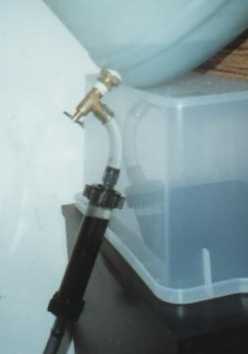
When you have finished filtering your spirit, do a final filter using say 250-500mL of water. This will flush the remaining alcohol which is wetting the carbon, and save you from throwing it away. Put this back in with the next wash you distill.
Kez has optimised this ...
-
I think I had a stroke or genius yesterday in filtering my spirit. I
usually run a litre of water thru at the end to get the final amount of
spirit out of the tube of carbon. To see when the water begins I just
sit at the end and taste the spirit until it tastes diluted, which is a
pretty grey area after about 20 tastes (yuk).
So yesterday I put in a litre of hot tap water instead of cold.
This told me 2 things.....
1. I could feel in the tube where the water was and it told me that all the carbon was being used in the filtration.
2. When the water was about to come thru cutting down on about 18 tastes, YES!
To celebrate my new knowledge I had a couple of scotches. I love it when a plan comes together.
To remove any of the very small carbon carbon particles left in the spirit, you can pass it through very fine filter material - down to 1 micron pore size. This will leave it crystal clear and clean.
From Cheryl (Victoria, Canada)...(posted on http://groups.yahoo.com/group/Distillers)
-
What I have found that
works well for me is, I add a 1/2 tbsp virgin oak
per 2 litre container, in with the activated charcoal
and treat for only 2 days (or it takes on the color,
of the oak) then filter, add water to 50% and, perfect
vodka.
-
Most people are familiar with "sugar vodka" and the numerous off flavors and
strange tastes and smells that a pure sugar wash can create, even when carbon
polished. It seems that everytime someone throws every random failed batch
of wine/beer/etc into a still and "salvages" the alcohol, the vodka it
produces tends to be the "smoothest batch I've made". Even though it was
made from homebrewer "remnants". Rather than trying to rely on a bunch of
wine or beer I'm not happy with, and can only turn into vodka, I found a
method to get the smooth taste of a "random batch vodka".
Simply make a pure sugar mash, using turbo yeast or whatever else you have handy. Ferment it out and distill it to 95% (or the best of your stills' capability). Dilute the spirit down to 40 to 50% and age it for a month on some uncharred American oak chips. About 2 tablespoons per gallon. Let this sit a month, until a nice oak flavor can be tasted in the spirit ( I try for Glenmorangie Scotch/gold in color), almost like a bland, one-dimensional, failed bourbon whiskey. THEN filter out the oak chips, add your carbon, and treat it as you normally would any sugar vodka. I have tried this with a small test batch, I am now soaking oak chips in ALL my vodka- even the stuff already carbon polished (I'll just re-polish it). After carbon treatment, there is no color and no wood flavor. The taste, however, is markedly improved. It tastes just like the wonderfull once-a-year-distill-all-the-remnants-I've-never-gotten-around-to-bottling batches people come up with now and then, but it can be done consistantly now! Appearantly the acid and tannin content in the oak mellows the spirit out through various chemical alterations/combinations, and these beneficial changes are noticable even when the flavoring compounds they form have been removed by carbon. Your sugar vodka will be the best in the neighborhood after this-and just as water-clear. Give it a try!
-
Activated carbon will work best when used in a granulated form as
a filling in a filtration column using the following method.
- Fill a tube 1.5 meters in length and at least 40 mm diameter with pre wetted granulated, activated carbon. Beware! The tube must be at least 38 mm diameter or it will introduce a "wall effect" where alcohol slips through the column without being purified. The filtration must go as slowly as possible without stopping, or the effects are much reduced. The filtration rate must not rise above approx 400ml per hour. Place one coffee cup of Norit activated carbon (0.25 to 1 mm) at the bottom of the column to reduce speed. With some carbons the speed can be higher.
- To get achieve maximum effect from activated carbon the filtration must take place through the carbon bed without channeling, and in addition, the tube must be free of any air. To accomplish this proceed as follows;
- Put the carbon in a bucket or kitchen pot and completely cover with 2-3 times more hot or boiling water. Mix for a minute and pour out any excess water. Repeat 4-5 times to wash out soluble material from the carbon.
- Place filter papers in the tube. Fill the tube fill with warm water, then top up with the pre-wetted carbon so it flows into water and no air at all remains in the tube.
- Filter 2-3 liters or more of water through the column to wash out any water soluble substances present in the carbon.
- Start pouring the alcohol to be filtered directly "onto" the water so that no air comes into contact with the carbon in the tube. Filter all of the alcohol in one run, again to prevent any air from coming into contact with the carbon. Run about 1 liter of water through at the end of the alcohol to flush out the last of the alcohol. Taste the alcohol and stop collecting when you detect water.
Jack agrees ...
-
I just started playing with my 5litre pot still again. The lack of copper in
the design is causing a seriously nasty flavor in the spirit. Everything
from kirsch, brandy, rum, and corn whiskey has come out tasting like rotten
eggs. By stuffing a copper scouring pad into the lyne arm of the still, I
took care of most of the smell, but some was still present. After several
runs, the copper scouring pad was to dirty to leave in the still, so I ran
the still (rum) without it. Sure enough- rotten egg smell intense enough to
burn the nose. So rather than wait 2 weeks for the gas to evolve off on it's
own, I put the spirit in a 2-litre soda bottle, and attached a Brita "sport
bottle" carbon filter to the top. I ran some tap water through it to get
the carbon dust out. I then filled the bottle with the rum. Bingo! the
sulfur smell is GONE. Absolutely no trace of rotten eggs. Here is the good
part, the rum flavor hasn't been stripped out at all! For those of you who
have made a wine, and distilled it into brandy- forgetting that you added
winemaker's sulfite- and got rotten egg brandy, just pass it through the
small sport bottle carbon filter- it will remove the gas, but not the flavor.
Now I don't have to wait for the stuff to sit for 2 weeks and worry about
the sulfur. Heck, now I can drink it warm- from the still to the filter to
the glass! Many thanks to "PK" and his brown sugar rum recipes- I'm havin' a
glass of it right now!
AuntyEthyl describes his setup ...
-
This system, uses a tube that is essentially sealed,
so unlike other designs, you can fill and forget,
rather than watch for overflow or needing to top it up
all the time. It is also designed around a 25ltr wash,
so will process about 10 ltrs of 40% spirit in a
single pass in about 36hours.
- Cut two layers of coffee filter paper to fit inside of the main pipe. Push these inside the main pipe until they rest at the bottom against the end cap.
- Fill your main pipe with activated carbon, to 50mm from the top.
- Pour the carbon into a glass bowl and pour boiling water over carbon. Stir, leave sit for a couple of minutes and pour off the water.
- Repeat about five times until water above the carbon is clear.
- Rinse filter housing. And fold silicon tube and clamp with a clothes peg. Fill tube with fairly warm to hot water.
- Pour off excess water from carbon and using a desert spoon fill tube with the carbon. Once filled, screw on threaded cap and top up water in filter. Push the clear plastic tube over the tap of the drum which has been filled with untreated spirit at 50% or less, the drum has also been suspended from the garage roof truss.
- Turn on the drum tap and adjust the aquarium air tap until the flow is quite fast, feel the filter pipe, as the spirit flows thru the pipe will cool, letting you know how far the spirit has flowed.
- Let the spirit flow fast until about two thirds of the water has been displaced. The water can be chucked, adjust the air tap until the spirit is just flowing, about 2 drips a second.
Secondly I apologise for the drawings, when it comes to Artistic, I'm all Autistic.
Materials
1 x 500mm long 50mm diameter upvc pipe
1 x 50mm end cap
1 x 50mm threaded adapter
1 x 50mm threaded end cap with O ring
1 x poly pipe barbed adapter (see drawing/see text)
1 x Caulking gun glue tube nozzle
1 x Aquarium air tap
1 x 1 meter+ of silicon aquarium air hose
20ltr drum with tap
Container to collect treated spirit (I use a fermenter)
Some coffee filter paper
Activated carbon
Some untreated spirit
| Note. The poly pipe barbed fitting is the barbed part of the poly pipe adapter that screws to a tap and has the barbed part to attach some poly pipe. | 
|
After studying my ordinary drawings, drill a hole in the centre of the end cap to suit the nozzle. This can be glued into position with silicon, from the outside. The end cap can then be glued onto the end of the main pipe. The barbs on the poly pipe fitting need to be filed down flush with the outside of the fitting, then a suitable hole drilled into the centre of threaded cap, and the poly pipe fitting glued into place. The threaded adapter can be glued onto the other end of the pipe.
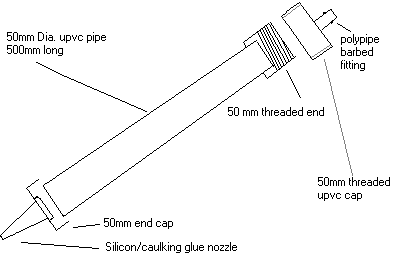
With the main filter unit built, all you need is a short piece of plastic tubing to fit over the barbed poly pipe fitting, then other end fits over the end of a standard drum tape (not the cobra/flip type tap)
To the caulking gun nozzle attach a short peice of silicon tube. The other end is attached to the air tap. A longer peice of silicon tube is used from the tap, leading into the collection container.
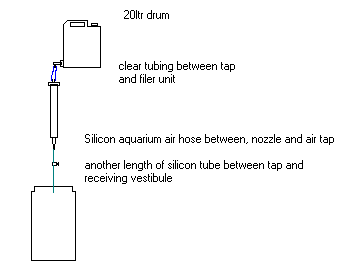
When you are ready to use...
You could even set up a recirculating system to do the filtering .... Jan asked about this ..
-
I like to have a small pump to force the alcohol through a carbon filter as
i find that the drip method id too slow in winter. I intend using a
windscreenwasher pump and feed the alcohol in the bottom of the filter and
draw off the top.i intend to achieve a fast drip with by-pass hoses.
Any better suggestions are much appreciated.
-
We found the easiest way rather than using a pump which is ideal
for circulating the alcohol through the carbon and which can greatly
accelerate the aging and purification of the alcohol was to have a closed
vessel with an outlet close to the bottom to which the final polishing
carbon filter is connected and into which the already treated alcohol can be
poured, decanted, or pumped, the vessel closed, slightly pressurised, and
then slowly filtered.
This produces a vastly superior product in a fraction of the time. Using a 2 or 3 stage process like this can lead to vastly shortened treatment times with each stage in the treatment process optimised.
In the vessel mentioned above I have a tyre valve fitted into the stainless steel lid and by using a bicycle tyre pump together with a precise pressure guage I can quickly pressurise the setup to about 2 psi which seems to be about the ideal pressure and which allows me to final polish 1 litre of spirit in about 1/2 hour. The final product is as fine treated product as you will find being crystal clear and even when left for weeks has absolutely no settlement or sediment. When left to just decant by itself (everything running downhill and thus gravity controlled) it took 24 hours + previously to filter the same volume. In this setup as stated I found 2 psi to be the best pressure although you may find it varies a bit with your own setup. Exceeding this pressure quickly led to possibly channeling with the alcohol being forced through too fast and some very minor carbon settlement resulting.
At the end of the day I found treatment and filtering rates were largely determined by the type and degree of fineness of the filter material used. Constant circulation led to shorter treatment times and ultra fine filtering led to a superior product. The main things are not to be too frugal with the carbon or to expect too long a life out of the filters. If using this method I suggest you do your own trials and tests especially of settlement and sediment. Even the clearest alcohol initially when left for some time will show very minor settlement. It is this aspect that with experience and patience you can gradually get perfect.
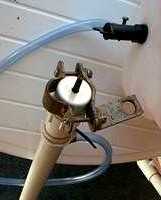
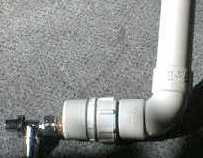
- ..I used a bike
valve to pump it up, even bought a psi gauge but found that it wasn't
necesary to check the psi. I can do a litre of spirit in 30 mins and as
you can see made it a flow through system so I just need to fill the
container and open and close the tap.
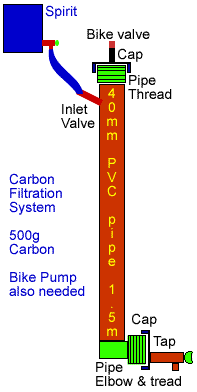
| 
 |
Jan writes about freezing when filtering ...
-
About carbon filtering: I Dilute the spirit app. 50/50 then use one spoonful carbon / litre (US. Quart), leave it for two days with occasional shaking.- filter through a coffee filter. THEN ---- I freeze it !!! Three days in the deep freeze at -25 deg. C. This makes the water and remaining fusels AND fine carbon particles stick together. Run it through a coffee filter as fast as it allows (filter density). What I'm left with is pure, clean, no smell alcohol which can be diluted to preferred strength (35 - 40 %).
-
Production of vodka
The 1982 US Bureau of Alcohol, Tobacco and Firearms (BATF) regulations define vodka as neutral spirit so distilled or so treated after distillation, with charcoal or other materials, as to be without distinctive character, aroma, taste or color. The use of charcoal filtration is now optional, whereas in earlier regulations it was mandatory and even the time and amounts of fresh charcoal to be used were specified. This change is in recognition of the relatively recent improvements in the quality of neutral spirits. Vodka is generally taken to be odorless, tasteless and colorless ethanol, but in the past in Eastern Europe vodka was lightly flavored with grasses or herbal extracts.
It should be stressed that not only is the charcoal treatment nonessential, it is also not particularly effective and will not make a poor quality, improperly rectified neutral spirit into a good quality vodka. Neutral spirit should be diluted to about 55% before charcoal filtration. The old BATF regulations (1961) specified dilution to between 55% and 40% at a minimum contact time of 8hrs with 10% of the charcoal replaced every 40hrs to give a minimum usage of 6 lbs of new charcoal per 100 gallons of spirit treated.
This was usually achieved by passing the diluted spirit through a series of eight or nine cylindrical charcoal filtration beds in a slow, continuous flow with one of the beds changed every day. The fresh bed would be connected last in the series. This meant that the beds were constantly being rotated; so the preferred arrangement was to set the beds in a circle to facilitate the changing. A simple alternative treatment method is to add charcoal to diluted neutral spirit in a tank and agitate or circulate it through a pump for a suitable length of time.
The water used in the initial and final dilutions should be clean, odorless and preferably demineralized. The demineralization is generally for aesthetic purposes as consumers do not like to see a white film of salts around the side of a bottle or glass if the vodka has been allowed to evaporate.
In countries where laws require that all spirits be aged in wooden barrels, it may be necessary to add a small amount of sugar and/or glycerin to be able to classify vodka as a liqueur or a compound spirit rather than as an immature spirit. The amount of sugar or glycerin used is normally the minimum required to provide proof obscuration. This occurs when there is sufficient dissolved material to cause the apparent proof obtained by direct testing to differ fractionally from the real proof obtained by distilling the ethanol from a sample in a laboratory still and retesting after redilution to the original sample volume.
Great care should be taken in the bottling of vodka to prevent contamination with residues of other odorous products. The tanks and bottling systems should be washed thoroughly if previously used for other products. However, some bottlers prefer to keep a set of tanks and a bottling line dedicated solely to handling vodka. For further reading on vodka processing seethe reviews by Simpson (1977) and Clutton(1979).
Reusing Carbon
You can reuse your carbon by washing it, and heating it up so that it will release any of the trapped fusels. Les explains ...
-
I have now reused my cabon which I use in the stainless steel filtering
column as described in Gerts manual 4 times with excellent results.I am
using 1 kilo which I boil for approx 30 minutes then rinse several times
with cold water. Because I am fortunate to live in the sub tropics I
place the carbon on a steel tray to a depth of 4 mm and leave in the sun
until dry.
The end result is nice shiney carbon no smell whatsoever. This product
could be reusable for a long time.I generally run 8 litres of 45-50%
through the filter each run.
-
The physical and chemical properties of carbon work in our favour and
mean that you have nothing to fear in heating it in an oven.
Thanks to the carbon atom having a strong covalent bond (x4) it is
very stable under normal conditions. The oven will never reach a high
enough temperature to even start to effect it. The heating of the
carbon should allow for the disappation of the built-up cogeners in
pores of the granules or powder.
Due to the fact that the nasty alcohol molecules will be released
over a period of hours there is an almost nil probability of an
explosion due to alcohol vapour build up.
If you have a fan assisted oven this is even better as it will help
to circulate the alcohol being released more evenly.
The bottom line is you could heat the carbon at top setting on your fan assisted oven for a year and still be in no danger. Wouldn't like to see the bill for the electricity though :)
As far as steam is concerned [from a domestic steam-cleaner] I do not think that would work. The alcohol molecules need to be vapourised from the fissures of the carbon. Water molecules (steam) would not do any more good than actually boiling the carbon in a pan of water as they would not necessarily displace the alcohol from the fissures.
-
Whilst its true carbon is activated by contact with steam, don't
think you can do it yourself while you're boiling the jug for a
coffee:
GRANULATED CARBON ACTIVATION
Most Carbon is activated using steam. Activation is also accomplished using chemicals. Wood based carbons steam activation involves a two step process, carbonization and activation. Carbonization occurs in an oxygen deficient environment at high temperatures, 700 degree Celsius. Activation of carbon occurs by using steam where temperature of the carbon is raised to 1800 degrees.
REACTIVATED CARBON
Reactivating carbon is a simple process where the spent carbon is thermally reactivated . Reactivation occurs a temperatures between 1400-1700°F where ether volatile organics or oxidized off forming CO2 and water. The non volatile organic compounds are carbonized to form char. In the final phase of the process steam is used to reactivate the carbon. Approximately 80-90% by dry weight of the carbon is recovered in this process. The remainder is made up with virgin carbon. Reactivated carbon performs exactly the same in adsorptive capabilities as virgin carbon.
Information courtesy of www.onionenterprises.com
-
I think you will find that the extreme heat procedures you read about concerning commercial reactivation of carbon are not necessary in a hobby situation. I regularly treat my carbon after use, and find that it serves me very well. Rather than calling it "reactivation", it is perhaps better to describe the process as "cleaning", as "activation" really means treating raw carbon so that it has a suitable internal structure with a very large surface.
- Wash used carbon in plenty of running water to get rid of all external rubbish. I do this simply by rinsing under a tap with the carbon in a sieve.
- Then boil it in an open pan of water for around quarter of an hour. This will get rid of the bulk of the volatiles. If you want to do a really thorough wash, carry on by boiling it up in an ordinary pressure cooker for 10 minutes. This will get rid of even more than open air boiling.
- Finally, strain off all the carbon and rinse under a tap for a minute, then spread it all out on a wide baking tray covered in ordinary baking foil (saves rusting the tray!).
- Shove that in the kitchen oven to dry slowly at around 160C/320F, making sure that you periodically open the oven door to vent the smelly steam that comes off.
Try this:
-
before i go through it i will say microwaving charcoal can be VERY
DANGEROUS! I got the idea of microwaveing it after reading that
carbon can reach extremely high temperatures in a microwave. You can
get carbon crucibles for melting steel and silver. So it reaches well
above 1000C. I thought this would be ideal to burn off and residual
nasties stuck in the carbon and also to sterilise it.
I get my carbon in a plastic filter from work. I cut the filter open with and dump the dirty carbon into a 40litre container and fill it with hot water in my shower. I let it settle and decant the dirty water. I repeat this until the water is clear, usually 4 times. I then boil it up in a pressure cooker to really clean it and sterilise it. I then drain it off rinse again and put it in a pyrex lasagne type container. I microwave it on full for 5 mins at a time stirring it after each 5 mins. After about 20 mins it is dry but keep a close eye on it. I then microwave it for 40 seconds at a time stirring each time. it looks dry but after a while it starts to gives off dry vapours again.
It gets extremely hot so a pyrex dish is essential. it is important to stir to prevent hot spots. Once i didnt stir for a while and when i did stir it was glowing red in the middle! after about 10 blasts at 40 seconds the vapors stop coming off and i then stop and let it cool overnight. the vapours have a choking smell and are a bit like smoke since they are "dry" but they dont stink the room or anything.
How much ? I didnt weigh it but it looks 500g judging from the 1 kilo bags i used to get. The microwave is 800W, but microwaves do vary in efficiency. Mine seems to heat small cups of water faster than my last 800W maybe it has hot spots or something. I would go very slowly your first time maybe 2 mins at a time until appears totally dry. When it is dry it just falls off the spoon like sand. if you cant leave it in the microwave to cool down (incase "she" finds it) be very careful where you leave it. I took it out once and put it on some newspaper and the paper started to smoke! it works very well when recharged, but i always put lots in each gallon jar anyway.
-
Carbon is a good conductor of electricity, so microwave radiation is readily
absorbed. However, high voltages are generated across the gaps between the
granules. Sparks result when the voltage jumps across these gaps. Air is a
good insulator, so this sparking will readily occur when the carbon is dry,
for the voltages can be very high indeed. Strong eddy currents in the
carbon heat the granules as it does have some resistance, so plenty of heat
is generated, usually ending up with the carbon igniting.
It's slightly different when the carbon is wet. Water is generally considered to be a good conductor, but that is only because it can readily dissolve salts that disassociate in solution into electrically charged ions, and these carry the current. Water that has been through the distilling process has no salt content, and any salts present in the carbon/water mix will generally be those lingering on after the manufacturing process. The water separating the carbon granules is therefore a fairly good insulator and sparking will also be experienced, usually with generation of a bit of hydrogen and oxygen as the water is broken down by electrolysis. The heat generated will initially go towards heating and vaporizing the water, so keeping the carbon below its ignition point. However, when all that water has boiled off, the dry carbon will then heat up - as before - and ignite. One "interesting" side effect you might notice if treating damp carbon in a microwave is that you can end up with an explosion, for that dampness may well contain a goodly proportion of alcohol if you haven't first washed the carbon thoroughly. The atmosphere in the microwave can quickly reached critical proportions with the oxygen in the air, and a spark is a tried and true way of igniting that mix! You can even get the same effect in an ordinary oven from a red-hot heating element if the carbon still has a lot of alcohol left in it ... ending up with a muffled thump and the oven door blowing open!! (Been there, done that, and would be wearing the T-shirt if it hadn't been scorched!)
Moral? Do NOT dry carbon in a microwave oven as the risks of fire or even explosion are too great, and wash carbon thoroughly in lots of clean water before drying in an ordinary oven ... keeping the oven door slightly open to vent any flammable gases that will almost certainly be given off, as no amount of ordinary sluicing in water will get rid of all the alcohols deep inside the carbon granules. Proof that they are indeed still there will become more than evident to your nose as they are vaporized ... so keep the kitchen windows wide open if you don't want the whole house to reek of congeners!
Drying Ethanol
The maximum purity you will get by distilling alcohol is around 96%. This is because the ethanol and water form an azeotrope. If you do manage to dry your alcohol beyond this, if exposed to air, it will simply suck in moisture from the air, and dilute itself back to th 96.48%. There are however various methods used to dry ethanol beyond there. Its important to do so if using the ethanol as a fuel, or using it to make biofuels. The water can be absorbed from the ethanol using zeolites (a molecular sieve), or even simple corn-grits. Note that you wouldn't use the limestone or copper sulphate techniques for drinking grade ethanol.Fred writes ...
-
I get my ethanol alcohol at the liquor store that is everclear. I put
about 1 inch of potassium carbonate anhydrous in the bottom of the quart
bottle of the alchohol to absorb any fissel oils or water since alchohol
is very hydrscopic to moisture. You just pour it dry and any water will
be absorbed
Ken wrote ...
-
... I finally have something
to report, namely, how BEAUTIFULLY zeolite (aka "molecular sieve")
works to suck the last bit of water out of distilled ethanol. I got a sample
of Type 3A Molecular Sieve from a place in So. Calif. called Adcoa:
http://www.thomasregister.com/olc/adcoa/molecula.htm
I got a can of the 4-8 mesh -- little balls of rock about 1/8" dia. -- they absorb about 20% of their weight of water over the course of a few hours. Take a liter of 95% ethanol, throw in 250g of stuff, swirl occasionally, filter out the next day thru a strainer, and presto! Anhydrous ethanol. Not expensive either -- $2.05 a pound US in 10 lb quantities, and reusable indefinitely. You drive off the water under a broiler for an hour.
-
Zeolites
The easiest way to get water out of ethanol is probably with molecular sieves (3A zeolite). It takes about 10g of sieve for each ml of water. 5kg cost about $100 and canbe reused hundreds, if not thousands of times. You could probably even rig up a solar oven or something to dry the stuff.
-- lhom@o...
Are you talking about the manufactured m.s. balls or the powdered or hammer-milled type here?
-- DAVID REID"
I suppose it wouldn't really matter. Larger mesh beads (1/8", 1/16") would be easier to recover, but it might take a little bit longer to sop up the water and regenerate the sieve. Powder would take more time to recover (you probably can't just decant, you'd probably have to filter) but would be faster in the adsorption and regeneration, I guess.
-- lhom@o...
These are your answer and 3A is definitely the right one but there are a number of problems and obstacles to overcome.
-- DAVID REID"
Quite a high start-up cost though, to dehydrate only 10 litres of 190 proof - although that will give you about 50 litres of biodiesel, if that's why you want to dry it. Also it takes 300-350 deg C to regenerate zeolite, more energy input, but maybe not more so than other methods which require redistilling. Maybe you could utilise the original boiler heat while distilling the ethanol to dry the zeolite.
-- Keith Addison
Molecular sieves work via adsorbtion. There are lots of little H2O binding sites on the surfaces of the molecular sieve particles (or beads, et cetera). H2O molecules 'stick' to these binding sites, EtOH molecules generally don't. Your sieves come wet. Heat them to about 200C for about 1/4 hour to drive off water. You don't have to do this, but you'll get better adsorbtion if you do. Best to do this at reduced pressure, if possible. Dump your dry sieves into the EtOH/H2O solution. Let it stand for 24 hours. Decant. You now have something very close to absolute ethanol. Keep it out of contact with air. It will take up water very rapidly, and you'll be back to 95% in no time.
-- "Greg Ederer"
Zeolite links:
http://www.bol.bg/zeoweb/zindex.htm - A piece of info about zeolites
http://www.zeolyst.com/html/faq.html - Zeolite FAQ
http://www.mall-net.com/mcs/zeolite.html - Zeolites
http://www.christison.com/zeolite1.htm - Zeolites brochure for website.
There's a great intuitive explanation of molecular sieves at: http://www.science-projects.com/analogies.htm#molsi
First, make sure it's dry, by heating to about 600 deg. F for several hours, thencooling back down in dry air. Toss in the required amount with your hydrous ethanol (molecular sieve zeolite absorbs like 25% of its weight in water) and stand back -- it can get HOT. Takes a few hours to get saturated. Oh, I'm sure the pros will talk all about columns of X dia. and Y length, with flow rates of blah, blah, but the simple ways are best. Good luck -- BTW, I only have free samples of this stuff. Did you actually have to PAY for it, and if so, how much (if you don't mind my asking :-)). Check out http://www.sorbentsystems.com/desiccants_charts.html for some good info and graphs.
-- K
Corn grits
If there's ethanol in your gas tank, there's a 50-50 chance that it was filtered through corn grits using a technique developed at Purdue University. When the corn grits get saturated with water you just make more ethanol out of them!
Drying of ethanol vapors - http://www.esb.ucp.pt/~bungah/downstre/vapordry.htm
Ladisch and his students at Purdue University found that drying of ethanol vapors saved energy and was economic. The corn industry makes ethanol by fermentation and has corn grits readily available. Passing the wet vapor over corn grits or other drying agents removes most of the water to yield a product that is close enough to absolute ethanol. When the drying agent approaches exhaustion, it is regenerated by heating and reused. Eventually the drying agent breaks down but has potential uses elsewhere in corn processing.
Source: Mike Ladisch; phone 317-494-7022; Internet,ladisch@e...
Limestone
Check Chapter 12 of the Alcohol Fuel Manual in the Files section at the list Website, "Drying the alcohol". You can access it with your browser (html files). Click on "manual - Alcohol Fuel Manual", the chapters are inside the folder. The file is called "manual12.html - Alcohol Fuel Manual Ch12". The list website is here: http://www.egroups.com/group/biofuel
The lime and calcium hydroxide settle out or are left in suspension, so distillation should remove it all. You'll need unslaked lime, ie quicklime (calcium oxide). The masonry shops only sell hydrated lime these days (calcium hydroxide). According to Stephen Mathewson's recommendations in the Alcohol Fuel Manual you'll need 35 pounds of lime per gallon of water = about 10 gallons of 180-proof ethanol.
Copper Sulphate
Here's an old chemistry trick: take the highest grade ethanol you can make and run it through a column packed with dried copper sulphate. In Europe CuSO4 is used to spray wines, so it's quite easy to obtain. 1 molecule of dry CuSO4 takes up 5 molecules of water forming a crystal hydrate: CuSO4*5H2O. If you haven't got a column just toss the crystals into a vessel, add hydrouos ethanol and stirr occasionally. The color of the crystals changes when they are "full". Dry the crystals in an oven (solar possibly) and reuse XXXX times. P.S.: The process is slow.
Always use crystalline hydrate forming compounds:
plaster (CaSO4*2H20)
burned limestone (CaO + H2O = Ca(OH)2)
copper sulphate (CuSO4*5H2O)
sodium carbonate (Na2CO3*2H2O) etc.
-- "Aleksander Kac"