
| Summary |
|
Use lead & cadmium free solder or brazing. Both aluminium and copper are safe to use, but stainless steel will prove more durable and easier to maintain. |
If you do need to make a still yourself, take care to avoid lead solder, etc which could contaminate ya. Use silver solder instead. Use only food grade type materials (eg stainless steel, glass, etc). Mine has an aluminium head on it - which is OK for the limited use it gets, provided it is kept clean & dry when not in use (or else it will pit & erode).
Copper is an interesting case - high levels of it are known to be dubious to your health, however it has been (and will continue to be) used for centuries in commercial stills (because of its excellent ability to transfer heat). This is because any dissolution is at such a low rate that you don't get exposed to enough of it. It is well known that the low wines produced in commercial stills can be a light green in colour due to their copper pick-up, however they are still below limits prescribed for potable water by health authorities. It would also appear that the copper helps convert some of the esters & organic acids present (which affect taste and odour), so that they're reduced. Some people who have built stills without copper have later added some back in (say using copper srcubbers for column packing), to because their highly pure (93%+ purity) spirit still had a smell present, which only went away when they put some copper in the vapour path.
For an excelent article on corrosion of metals, and the problems this causes when building brewing equipment, see Corrosion Problems in Brewing by John Palmer.
For information about using Brass, see http://www.brewinfo.com/mybrewery97/mybrewery3.html
For suppliers of brass needle valves, search the following sites :
http://rswww.com/ (UK), or
http://www.cornerhardware.com/hardware (US)
For heating elements, Reima recommends ..
-
my Immersion heaters can be had at Haymans or CNW Electrical Manufacturer is "LN Elements" Type
RHM 12 and they are in Melbourne Phone 03 9427 7066
What to Use for a Boiler ?
Http://www.kegs.com is a good place to get beer kegs in the USA. The used 50L kegs are about $20 US dollars. They make good boilers and fermenters.If you need instructions for how to remove sanke ball valves from kegs, see http://www.stpats.com/oakbarrels.htm
For those residing in Oz, The Visypack plant in Brisbane produces a food-grade 60 litre stainless steel drum. The "full open lid" version, retained with a clamp and nitrile (alcohol impervious) gasket sounds ideal for a boiler. Visypack's address was soon to shift to: 40 Ingham Place, Hammett. The contact person is a Jim Klear (pronounced "clear"), Phone no. in Brisbane: 3890 9777. Price: Aus$154.66. Update - have just heard its now $348 - probably a bit too steep to consider !
Rheem Australia the hot water system people has a factory in Bulimba (Inner southeast) Brisbane Queensland Australia. They make the beer kegs etc for the breweries amongst other things and I believe you can also get 60 litre SS drums from them as well.
http://www.skolnik.com specializes in steel drums (including salvage drums and barrels) which would be suitable for distillers.
What Materials are Suitable ?
Coulson, Richardson & Sinnott report that:- aluminium, aluminium bronze, brass, copper, gunmetal and bronze, high Si iron, nickel, nickle-copper alloys, platinum, silver, stainless steel (18/8, molybedenum & austenitic ferric), titanium, tantalum, and zirconium
- nylon 66 fibre & plastics, PCTFE, PTFE, polypropylene, and furane resin
- hard rubber, neophrene, nitrile rubber, chlorosulphinated polyethylene, and silicone rubbers
- concrete, glass, graphite, porcelain and stoneware, and vitreous enamel
- lead, mild steel (BSS 15), cast iron, and tin
- acrylic sheet (eg perspex), acrylonitrile butadiene styrene resins, rigid unplasticised PVC, plasticised PVC, polyethylene (low & high density), polystyrene, melamine resins, epoxy resin, phenol formaldehyde resins, polyester resins
- butyl rubber & halo-butyl rubber, ethylene propylene rubber, soft natural rubber, and polyethylene rubber
- wood
Plastic
Plastic is basically fine at the low alcohol end (eg the wash, and even the diluted product), but if possible, try to avoid using it where it is likely to encounter strong alcohol. For alternatives, consider using copper tubing from the condensor to the collection jar, and using glass collection & storage jars.From Ken Schwartz's page (sorry, link dead) about building a plastic brewing setup ...
-
... I made sure the buckets were at least 0.090" (90 mils) thick by
checking the thickness "rating" embossed on the bucket bottom --
I found that the cheapo 0.070" buckets I experimented with earlier
on allowed the element to sag when it got hot, but the 90 mil units I
found were just fine. I ended up changing to a 7-gal HLT (see below),
same as my boiler. These 7-gal buckets are both 100 mils thick and
handle the heat very well.
-
I obtained a cheap used 60l (25 USgal) plastic drum with a band clamp
like those on paint tins. Looked more solid than my plastic jug in
the kitchen. So I obtained 2, 240V, 1500w electric jug replacement
elements which can be easily attached to the drum by simple drilling
and screwing tight (from ray@moonshine.co.nz). Converting beer
barrels and hot watersystems did not appeal to me - I like easy
solutions as I'm not a great handyman. I intend to use two for the
initial boil, and then use one for my 40mm diam X 1m column which
appears right to prevent flooding.
What plastics are suitable for boiling washes? See: http://www.plasticsusa.com/polylist.html
Appears HDPE and polypropylene are O.K.
Utilization temp (deg. F) for HDPE is -180 to +248 with a melting point of 266.
Utilization temp (deg. F) for polypropylene(PP) is -15 to +266 with a melting point of 338.
Oviously polypropylene is better, but high density polyethylene is acceptable. Plastics are slightly permeable so be careful what they held if purchasing a used one. The inside of my kitchen plastic jug looks vey stained, but then so what.
-
The technology of materials is constantly changing but the
chemical resistance does not. Food grade, 'Flexible",means modified in most
cases and it means plasticisers are compounded into the polymers to make
them more flexible,these are not always stable ,especially at elevated
temperatures and in contact with alcohol at these elevated temperatures and
high concentrations...I do not use any plastic in my operation until I cut it down in
strength.
Ses adds
- Tygon tubing should be inert. We used to use it for collecting biological
distillates. Alternatively, glass piping could be used, but you would need a
bunsen burner and some pretty good skill to "bend it" into shape.
- You can check chemical compatibility here:
http://www.coleparmer.com/techinfo/ChemComp.asp
Cole-Parmer: Chemical Resistance Database : Chemical Compatability
To search, select at least one of three criteria to search on. If you wish to search by compatability level, you must specify a chemical or material.
This helps with identifying different kinds of plastic: American Plastics Council: http://www.americanplasticscouncil.org/benefits/about_plastics/resin_codes/resin.html
And this helps even more: http://www.midmichiganspe.org/education/identification.pdf Society of Plastics Engineers, Mid-Michigan Section Plastics Identification
-
Please consider this:
PCV a thermoplast is a polymer that can easily be recycled, see: http://en.wikipedia.org/wiki/Polyvinylchloride.
Years ago a soft version of PVC was produced by adding polychlorinated biphenyls (PCB) as a softener. I think that in most of the world the use of PCB's is banned now. But just imagine a company recycling "cheap" soft PVC in their PVC sewer pipes to make them less brittle! Be sure to use food grade PVC pipes and not the (clean new) cheap PVC sewer pipes. To give you an idea what PCB's can do: http://www.foxriverwatch.com/monsanto2a_pcb_pcbs.html
Galvanised Metals
Tarvus explains ...-
Galvanised materials are not safe to use on the condenser side, but if it's part of the
boiler or at the bottom end of the column, it should be fine
(provided you don't boil so vigorously that your wash bubbles up
through your column and into your collecting container. Toxic salts
from metals can be dissolved in liquid, but remain behind when the
liquid is vaporized (as in a reflux column).
For example, you could toss a handful of lead fishing sinkers into your boiler which could well leach toxic levels of lead into the wash. But once the vapor runs through the column, it's free of the lead salts and safe. If you used lead based solder (or galvanized parts) in your CONDENSER, that would be a different story. The hot liquid condensate could leach lead salts from soldered joints or zinc from the galvanized parts and you would wind up with contaminated product.
Solder & Braizing
(A compilation of newsgroup emails by Robert Warren, Pete Sayers, David Reid, James Witten, Howard Anders, Allan Goldsmith & Scott (the yldog) - thanks guys !)Solder
Is solder safe to use ? Tin and silver solder is perfectly safe, and in fact is commonly used for soldering copper and/or stainless steel for food use. The main "ingredients" in solder we need to avoid are cadmium and/or lead. BTW tin is the material used to coat the inside of "tin cans" in making of canned foods - ie its very safe to use (Actually steel cans of course, which are plated with tin to make them corrosion proof.) Most states in the US outlawed lead solder back in the mid 70's.There are a couple types of solder currently sold on the market:
- Silver solder, is mostly tin and a small
amount of silver. It does take a bit higher temperature to get it to
flow, but has excellent adhering properties. In fact, if you want to
solder something which will never come apart, unless you use an even
hotter torch than what you soldered with in the first place, then
silver solder it. You may want to use Mapp gas instead of propane
to get the higher flame temperature (around 650 F / 345 C ?).
Regular silver solder may have some cadmium in it; Check that you are infact using cadmium free silver solder (for use on food related equipment (stills)).
- The other main type of solder is simply called 95/5,
which is 95 % tin and 5% zinc. It flows easily at a lower temp,
(around 500 F / 260 C ?) and will just run off instead of sticking if you get
the joint too hot. You want to work this solder at close to the
melting point. This is what most plumbers have used on domestic
waterlines arouund the world for the past 25 years, and it is
completely safe, as is the silver solder. Plumbers use 95/5 because
it is about 25% cheaper than silver solder.
Now, given the fact that alcohol is a known solvent, and the other salient fact that you have hot alcohol vapors inside a still, it is reasonable to wonder about the how much tin and such may dissolve. Well, the tin is pretty good at sticking to the copper and also to the adjoining tin molecules, and it really is not very soluable at all. Some geographical areas have well water which is highly aggressive, perhaps a stronger solvent than alcohol. Such water will dissolve out the zinc in galvanized pipes and then continue to react with the iron underneath and you end up with holes in your pipes.The zinc on alvanized pipes and inside water heaters is considered a sacrificial metal. However, the zinc in 95/5 is bound to the tin and is an alloy, so it has completely different properties than the zinc coating on steel pipes. Anyway, the long and short of it is that zinc, tin, and copper are found in tiny trace amounts in our bodies along with gold and silver.
Brazing
To learn more about how to braize, see http://www.handyharmancanada.com/TheBrazingBook/bbook.htmBrazing definitely makes a vastly superior job to soldering and is also more permanent too.In short there are a number of materials;
- Silbraloy (sometimes mistakenly called Silvaloy) at the bottom of the range starting with 2% silver,
- Silphos with 5% and 15% forms and one or two other proprietary materials, and
- Easyflows which have silver contents from 30 to 56%.
Silfos is an exellent product to use. It takes a much hotter flame, so you may need to use Mapp gas or even acetylene (it melts at around 800 F / 425 C ?). Quite high, compared to solder. It is a phosporous bearing product. It is unique in that you don't even have to flux the joint, but it should be thoroghly clean,as with all soldering. It is very strong, and the other feature is that it is strong enough to use to repair a hole in apressurized water pipe (you can't solder with water in the pipe) but it can be worked like a brazing rod and so you can fill holes with it.
Prices start at around NZ$30 kg and go up to NZ$400 kg for the more specialized materials. The more silver and other additives the higher the price.
Also in short you get what you pay for and the skills and experience of the welder then become important. If you have a good welder he could probably use Silphos 5% but I would probably use 15% ( Good capillary flow for tight up joints. High stress resistance) if you want a good neat job and you dont mind spending a little more. Either Silphos 15% or a bottom end Easyflow (such as 30% but a bit dearer again. Good gap filling and build up. Good flow characteristics) are probably the best for this job and the little bit more you pay for the material are generally compensated for in the welding time saved. Personally I wouldnt pay more than $80 kg. Consult with your welder as he is the guy with the experience and as long as he is honest and has the skills you should be pleased with the result. If he is an older plumber who did his time using copper plumbing pipe you should have no problems.
John writes ...
-
..Soldering this heavy copper was tricky as the standard small
hand-held propane tanks do not provide enough heat. So I bought a canister
of MAP-gas. At first it would not work, but a phone call to a plumbing
contractor gave me the following:
1. scour the to be soldered surfaces with sand-paper. Any kind will do. But get them clean.
2. use FRESH solder paste. This is an acid paste that melts as the heat is applied, and further cleans the surfaces. Use the paste liberally! I found that I had to restrict the paste to the very areas I wanted to solder, as that is where the solder flows.
3. Use lots lots of heat.
Is Aluminium Safe to Use ?
Heres what the rec.crafts.brewing Frequently Asked Questions (FAQ) (version 2.12) has on the subject.-
There has been a good deal of "discussion" as to whether or not the
use of aluminum in brewing contributes to Alzheimer's disease. Thanks
to Oliver Weatherbee for providing to following:
Aluminum has NOT been linked to Alzheimer's disease. The following is taken from "Frequently Asked Questions About Neurological Problems" at The Department of Neurological Surgery of The Cleveland Clinic Foundation (http://www.neus.ccf.org/patients/faq.html):
"There is little support for the theory that aluminum causes Alzheimer's disease, the most common cause of dementia in the United States. The exact cause of this disease is unknown, although the risk of Alzheimer's is higher when there is a family history of this disease.
[two paragraphs removed]
Workers exposed to high levels of aluminum in industrial environments have no increased incidence of Alzheimer's disease. Furthermore, careful studies to date have not shown an increased aluminum concentration in the brains of Alzheimer's disease patients.
Since there is no convincing evidence linking aluminum toxicity with Alzheimer's disease, you need not worry about exposure to aluminum in cooking utensils."
Furthermore, Brewing Techniques (Jan/Feb '95) had an article on a parallel brew experiment using an aluminum brewpot and a stainless. Laboratory analysis showed that there was no significant difference in trace aluminum levels between batches. They also pointed out that most of the Al you digest is from your food and water. And for that matter, many medical people consider copper a bigger health risk.
As for off flavors, IF this happens (hearsay IMO), it is probably the result of the brewer scrubbing the oxidation layer of the pot during cleaning. Don't scrub, use a soft cloth or sponge and non-abrasive cleaner. This is one of the reasons Al is not used much commercially, its not caustic cleaner friendly.
-
Al has two primary disadvantages:
- Acidic wash will cause pitting over time, which destroys the vessel. This can probably be mitigated by neutralizing the pH of the wash prior to distillation with some calcium carbonate or similar.
- Al cannot be effectively soldered or brazed - and soldering is a primary method of joining still parts for the home handyman.
Cleaning Aluminium
Ted advises ..-
Do not use sodium hydroxide (NaOH) - lye - for cleaning with aluminum!!! the reaction will
produce hydrogen gas and eat the aluminum. Treat aluminum like you would
copper.
Is Copper Safe to Use ?
Copper has been used for centuries in still design, despite its slight solubility. This is primarily due to its excellent heat transfer properties, making it excellent at cooling the vapours. Although some copper will leach into the distillate (low wines are sometimes a light green in colour), it is usually well below health limits for potable drinking water.If you haven't fully rinsed off acids used during cleaning, then it can react to form copper acetate (verdigris). This stuff is toxic, with an LD50 (Ingestion) of 196 mg/kg (mouse). This is a small number - it means that a 90kg person would need to consume 17.6 grams of it (half a scrubber by weight ?). This stuff is slightly different from the "green rust" you see on copper if it isn't dried fully each time after use. However, all copper salts are toxic if consumed in chronic volumes. 2-5 mg / day is essential for good health, however levels above this will be dangerous. 10-20 g is considered fatal. Your body will slowly flush itself of copper, but approx 30% of copper salts ingested will stay in the body. The half life is 13-33 days with 70-150 days to completely clear any one incidence of ingestion. In simpler terms, we're not at risk in using copper for the fittings in the still, as the rate at which we're oxidising the copper is a lot slower than rate our body can handle it. In addition, given that the reacted copper is water soluble, a decent rinsing after each cleaning & use of the still should take care of removing it. The greater likely risk is from inhaling the dust when cleaning dry copper. Make sure that you do your cleaning in a well ventilated room, and possibly use a mask if you're putting dust into the air.
It would be rare to find a commercial distillery that didn't use copper.
Several sites actually recommend some benefits from using copper, as it is said to remove sulphur & form more esters (flavour)
Helge Schmickl of http://www.schnaps.co.at/ writes :
-
According to relevant literature, copper should theoretically reduce the amount of
esters/organic acids because of its catalytic impact. Basic rules of
organic chemistry point to the same outcome. But we didn't notice any
difference in taste/smell when distilling simultaneously with two
equipments, one was completely made of glass, the other one of copper.
The fermentation has a much greater effect on the result. Esters and
especially organic acids arise from misfermentations of leafs/twigs or
rotten parts of fruit. Work as clean as possible during the whole
fermentation process and use cultivated yeast. Then you shouldn't have
any problems with esters/organic acids.
Try this: Fill a copper-tube (length appr. 30-50cm) with copper wool.
Put this tube between the distilling pot and the cooler (condenser)- you SHOULD notice a difference.
The following comments are from the Macallan Distillery at http://www.themacallan-themalt.com :
-
The size and shape of the stills are crucially important. The more contact
the wash and low wines have with copper the better, since it acts as a catalyst,
removing sulphury impurities (in the wash still) and promoting the creation of
esters (in the spirit still) - effectively cleaning and lightening the spirit.
Small stills with a broad 'head' (the middle part of the still), such as those
at Macallan, are best of all: a narrow head tends to increase the velocity of the
ascending vapours and to reduce their contact with the copper walls.
Finally, while we are on the question of still design, there is the important matter of the length and angle of the 'lyne arm' - the pipe which connects the top of the still, known as the 'swan neck' to the condenser. Macallan's lyne arms are of average length, but they are acutely angled in a downwards direction. This means that once vapours reach the neck of the still they are more likely to go over and be condensed than to fall back as reflux and be re-distilled. Again, the Macallan is unusual in this: most distillers set out to increase reflux. But then, they may well not achieve such copper contact (with its spirit-enhancing properties) as do Macallan's small stills.
-
I wonder why this German manufacturers swear so much on copper for their material of choice for still making. In a material they sent me says verbatim: "Pot stills are traditionally made of copper for numerous practical purposes: copper adsorbs volatile sulfur containing
compounds which are produced during fermentation and the presence of which is undesirable in the distilled spirit; copper is an excellent heat conductor that helps prevent burning of the mash; copper prevents the production of ethylcarbamat which is a toxic substance formed from cyanides (cyanides are found in high concentrations in pitted fruits); copper also improves the quality of the final product, if the quality of the mash is not microbiologically perfect; and, copper and some distillers might even argue a particular shape of the copper improves the aroma of the final product."
-
I am a little puzzled by the absence of copper in a lot of
your boilers. It took me several months of searching at various libraries to
discover why boilers should be made from copper. I accept that, prior to the
advent of stainless steel, copper was the logical choice due to its
malleability and conductivity . However, large commercial stills are still
made from copper and not, to my knowledge, from SS....why? My research
turned up the following and I was wondering if those amongst you with a bent
for organic chemistry would care to comment. During the heating of the wash
fatty acids are produced. These give rise to off-tastes and they are
apparently not too good for you as well. However, if they are formed in a
boiler made from copper they bond with the copper in some way and do not go
through with the distillate. If you use SS they pass through with the
distillate. This does not mean that SS is not to be used. All one has to do
is to add a couple of handfulls of small copper pieces to the SS boiler.
- copper adsorbs volatile sulfur-containing compounds which are produced during fermentation and the presence of which is undesirable in the distilled spirit;
- copper is a very good heat conductor that helps prevent burning of the mash;
- copper avoids the production of ethylcarbamat which is a toxic substance formed from cyanides (cyanides are found in high concentrations in stone-fruits);
- copper also improves the quality of the final product if the quality of the mash is not microbiologically perfect; and,
- copper improves the aroma of the final product.
At http://www.drinktec.com/ I found the following which adds to the copper knowledge base ...
-
Pot stills are traditionally constructed of copper. The reason for this adherence to copper has
numerous practical purposes:
-
What copper does is that it catalyses the breakdown of esters and
sulfuric compounds. I did not know about the catalysis of fatty acid breakdown, put it is
possible that it does that as well.
Exactly as you say you only need to have a small amount of copper
present somewhere in your still to get this effect. I use a copper
refluxcooler.
I don't believe that the copper actually forms a bond with the fatty
acids. It is probably a catalysis we are talking about.
And the end products probably go through to the distillate to some
amount, but not in their original foul-tasting form.
-
have found in my years of distilling, that when the vapor comes in contact
with copper it imparts a flavor to the final product. I have also found
that, while it does offer a bit of difference, copper in contact with the
wash does not have as much of an effect.
Therefore, due to my experiments and years of working knowledge, I have come to the conclusion that in order to gain the desirable flavoring that copper adds, it is beneficial to have copper in the area that the most vapor will be in contact with it.
-
I just got a 5litre "export still" - the small potstill on your picture
pages. For the record- "out of the box" it can get you 55%abv with a
starting 15% mash. With half of a copper scouring pad pushed up into the
lyne arm- it increases to 65%abv+. The lack of copper gave the first trial
batches a sulfur odor, but this went away after two days in corked bottles.
The copper scouring pad, and a length of copper tubing force-fitted into the
lyne arm took care of that, though. This indicates my previous experiments
were flawed. My fermentations take place at low temperatures, as a result, I
get very little sulfur production. The "quick batches" I made to try this
thing out quickly had enough to carry over into the spirit, a copper plate
on the bottom of the still body did nothing to help- the copper placed in the
vapor path made all the difference in the world. I guess that is where the
copper is most usefull, as far as flavor goes.
- Don't ever make the mistake of buying these .. they are
clearly labeled 'Copper Scourers' but 'Copper Washed Mild Steel Scourers'
is more accurate.
I ran these in my reflux column - 2 runs. After the second run, I left the still set for a day (my bad) and when I went to break it down, all of the 'Copper' scourers had turned to heaps of black (ferric) oxide. The ones nearest the bottom had the consistency of freeze-dried plant material, whereas the ones nearest the top still had a slight bit of structural integrity - but were still mostly black.
I should have tested them first, they stick firmly to a magnet..! If these things are actually plated, they may have had a layer of zinc deposited atop the steel before the copper. Nasty, nasty, poorly labeled junk product. Beware.
BeerGuy reports:
-
The article is by Lew Bryson and it appears in the Volume 13, number
3 edition of Malt Advocate. The title of the article is Gleaming
Guardian: Copper Stills aren't just a pretty face. Mr. Bryson
interviewed several people for this article. Among them were Dr.
Bill Lumsden from Glenmorangie, Chris Morris and Lincoln Henderson
from Brown and Foreman, Barry Walsh from Irish Distillers, and Jim
Murray author of Jim Murray's Whiskey Bible. All these guys must
know what they are talking about since it is a fundemental part of
their job.
Anyway, to preface the article and to acknowlege some of the speculation regarding my last post, the culprit of the corrosion and subsequent destruction of copper stills is sulfur. According to the article the sulfur comes from the grain itself, but it can also come from bacterial infection of the must prior to distillation.
As the must is distilled the sulphur compounds wind up in the spirit. The copper in the still causes the sulfur to combine with the copper and form copper sulfate. Aside from the copper sulfate there are other oils and fats from the grains and these combine with the copper sulfate as well to form a black compound. According to Lincoln Henderson, this black compound forms on the spout of the spirit safe and he reports at the Woodford Reserve Distillery it is quite heavy. The reason why Woodford Reserve has such a thick, heavy greasy black deposit is because they distill bourbon and not whiskey. As you know Bourbon has substantial amounts of corn, and with corn comes corn oil. Chris Morris refers to it as Grunge and it smells heavily of copper. It is also difficult to remove from your skin. According to Chris Morris the grunge starts at the top of the gooseneck, the lyne arm and all the way through the condensation structure. The tail end of the Grunge eventually comes to the spirits safe. Barry Walsh notes that this effect works the other way in copper mining, in this case fats and oils are introduced into a solution heavy in copper to extract the copper from the base solution.
According to Morris the Grunge is actually a polymer called ethyl carbonate and according to him when distillers refer to EC levels in their process it is ethyl carbonate that they are discussing, the copper essentually cleans this out of the spirit.
Morris reports that to clean the grunge out they run a caustic wash through the still, what results is a waste water product that is high in zinc and copper, which cannot be processed by their local wastewater utility. Morris reports that this caustic wash is mixedw with spent mash and sold to farmers, where the addition of zinc and copper is a benefit to dairy cattle.
Bill Lumsden states that the best place to utilize copper is where it is where the hot vapors are condensing. He makes reference to shell and tube condensors which consist of a copper column with 250 narrow copper tubes inside. There is much more copper surface area in a shell and tube condensor versus a worm type condensor. In his experience he states that a spirit distilled using a worm type condensor is much more meaty and sulfury in character than that using a shell and tube condensor.
Column Stills are discussed in the article. Post repeal when the distillery business was starting over from scratch a lot of distilleries started to utilize stainless steel stills. When this occured they noticed the immediately the difference between copper and stainless steel stills. According to the article Seagrams did extensive research to figure out what was going on. Essentially, Morris states that at Jack Daniels 100% copper column stills are used, while at Old Forrester a hybrid stainless and copper still is used. In the hybrid still all the internal infrastructure of the still is copper. Mr. Henderson also interjects that they also throw a lot of copper pieces into the top of the still, basically just a bunch of short sections of copper tubing, which lasts until it essentually disintegrates. The scrap tubing that they put into the still at Brown and Foreman last about 3 years and when it is eventully removed it is very brittle, about the thickness of paper and will crumble in your hands.
Mr. Lumsden states that the life of a still varies according to the distillation schedule, basically saying the more you distill the more copper dissolves. From his experience he states a 10 year lifespan for the neck and lyne arm, For the spirits still, the main body goes first and that is usually in 8 to 10 years.
The article closes with a few observations. In one, Mr. Lumsden states that the still gives itself up to the whiskey. Mr. Murray puts it more plainly and states that copper is self sacrificial and that every time a copper still boils away it is giving part of its life to the whiskey. Barry Walsh had the most important comment to make, he states that modern distillers could get away with a small presence of copper in their stills, but there is a thing of beauty associated with large polished copper pot stills.
My observations from the article are as follows.
First these are huge stills with very thick sections of metal. The corrosion that they are experiencing is pretty dramatic considering the volume of product they put out and the size of the still. I can't imagine the capital cost involve in replacing a commercial sized still every 10 years or so.
Second, copper is only important in those areas of the still that are exposed to vapor, that way the copper can do it's thing and the end product will still be as good or close to what is produced in a all copper pot still.
For a small 'hobbyist still' and the amount of mash distilled per year, the whole problem with corrosion is insignificant. I do expect that those who use copper in the column packing will probably have to replace their packing every few runs or so.
My opinion would be to use a stainless steel tank and attach a copper still head to that, you'd be way ahead of yourself.
Cleaning Copper
Ted advises ..-
If you used bleach or any other high pH cleaner, the inside of the copper
tubing will corrode and give off dark colors. If you weren't using corroding
cleaners then you're not as clean as you think you are. The best cleaner for
copper tubing is mild acid like phosphoric or nitric acid. Run a gallon of
5% acid though it about 10 times and rinse with 2 gallons water.
If your still is made of copper NEVER clean it with bleach! In fact, it doesn't matter what your still is made of, DON'T USE BLEACH! it corrodes just about every metal out there. I seem to say this over and over but no one listens!!! Bleach is great for sanitizing glass, plastic and wood fermenters and is the only place that you should use it.
-
Use Hydrogen Peroxide instead in most
applications. This tends to sterilize rather than just sanitise and it
also just breaks down to water and oxygen unlike bleach which kills fish
and plant life including algae and which end up polluting waterways and
the enviroment generally. The chlorides in bleach also attack and destoy
metals including ss. This is a point that has irked me for years and one
in which the so-called more advanced civilized societies and man in
general are so backward and dumb. The only place I tend to use bleach is
a few drops in fermentation locks so algae and bacteria dont grow and a
little in the bucket of washing liquid when I mop the floors.
-
I just found the perfect cleaning agent for copper. Since I can't get nitric
acid, I decided to use whatever acid I had on hand: VINEGAR! I took a copper
elbow that was brown, streaked, and corroded and totally covered it with
vinegar. In about 20 minutes it was bright and shining. No scrubbing or
anything, just a soak, then a water rinse- spotless copper. Try it, it's
worth it.
Winding Copper Coils
Sometimes its hard to make a tight coil without crimping the tubing. Nic writes ...-
The hardness of copper tubing is determined entirely by the amount of work
hardening that it has been subjected to after it was last annealed.
So to make winding a tight coil as easy as possible you want to anneal your tubing before you start AND reanneal it whenever you have work hardened it (by bending it etc.) to the point that it becomes unworkably stiff.
To anneal copper just heat to bright red, hold for about two minutes and cool. The cooling rate is not critical since copper is not heat treatable. This will make your tubing dead soft.
The annealing process will leave a black and/or red copper oxide on surface of the copper. To remove this either scrub it off or soak in warm 20% sulfuric acid until the oxides are removed and polish if desired. Be careful and observe proper safety precautions.
You should be able to get 20% sulfuric cheaply as "battery acid" from any auto shop.
-
1/4" tubing, if softened first by annealing ... heat until copper starts to change color and then leave to cool (or quench quickly in water ... it makes no difference with copper) should require no filler to bend without kinking. Just wind slowly around a dowel or other former, pulling hard on the free tubing as you do so.
If you must use salt to pack a tube, use very fine table salt. If the grains are still too big, you can easily grind it finer with a pestle and mortar ... or even a rolling pin on a hard flat surface. It powders very easily. Taping a cone of paper around one end of the tubing makes a nice funnel that doesn't take up space inside the tubing. Tap the tube often, as advised by 'trailsendag'. Make sure the salt is very dry before you start pouring by leaving it on a tray in a warm oven for half an hour. Even iodised salt soaks up some water from the air and will not pour as easily as bone dry salt.
1. Buy tubing with wall thickess of 0.030. This is refrigeration tubing and comes in 50' coils. It's *maybe* five thousandths thicker than standard kind from the hardware or Home Depot/Lowe's type chains (but same price!!!). I'm not even sure it's any thicker, but I know it works perfectly.
2. Get a mandrel for appropriate size at least a foot long (18" is better).
3. Allow at least 2 feet to overlap the mandrel toward your lap, with the remainder out in front in the floor. Keep the tubing 90 degrees to the mandrel.
4. Now with the 2 foot section in your right hand (let it extend up under armpit if necessary), and the remaining length in the left, pull with each hand in opposing directions as hard as you can (use Zen; become 'one' with it ha ha) while only trying to bend the pipe about an 1/8 to 1/4 turn at most around the mandrel (downward toward the floor). Do NOT go any further.
5. Now examine the tubing; it should be only slightly flattened where you first contacted the pipe. Repeat step 4, pulling with all your might while adding another quarter turn.
6. Now that you're nearly half way around, turn the rig over so that the short end is sticking up in the air. Continue by holding the longer length with left hand still...and pull upward as hard as you possibly can while bending to about 3/4 way around. Repeat and finish one turn
7. Now here is the trick. You got it around and it isn't kinked and it's tight to the mandrel; now keeping constant tension on the whole works, use the *short end* to make 3-4 turns around the mandrel (leave as much as you want for water connections). Why is it the trick? Well 'cause you've turned the first few turns with the short, manageable end - and now you can grasp it for the remainder!
8. To finish means we *switch techniques*: Now stand up...and take the coil in left hand and put a tight grasp on the coil with locked thumb and fingers - and - bearing down on top of your left knee - keeping constant hard tension on the remaining tubing, *turn your wrists* outward to roll the tubing onto the mandrel. DON'T try to just wrap the tubing around like a sissy or it will not fit tight to mandrel and possibly kink. You can switch hands/legs to get a rest.
Roll down, then back up the same way and you'll have a perfect double-helix coil without salt or anything.
Figure 10' of tubing for a 4.5"-5" long double-helix for 1.5" column , and 20' for a 6 incher for a 2" column.
It's hard work for any method, so just roll a few turns and rest often. Don't rush it, as was advised earlier.
Remember, there are 3 tricks: Start with at least 2 foot and wrap first 4 or so turns with *short end*; constant, hard, tension during entire process; change techniques wrapping the last part by rolling wrists.
Gaskets & Seals
Tarvus gets back to basics ..-
A bit of white bread and water kneaded into a dough like paste works
as a good temporary seal. Use it like a putty. It will dry but
retain an airtight seal.
-
Had the pleasure of testing my latest V3 on a water only run yesterday. Had a couple of minor leaks on the
column, due to its design (pull apart column) , but enough of a leak to be concerned.
Enter flour and water... made a 'dough' mixture and smeared it into the gaps. Start still running, by the time the still hit operating temps... the dough had set.. and no leaks. :)
-
I made a still with a soup pan and a doughbowl, the seals I tried
were;
- rubber gasket - too stiff and smelly
- silicone rubber tubing sliced open - well ok sort off, not perfect
- silicone gasket or as the packing say's Form-A-Gasket no.6 I aplied it as a thin stripe and let it dry. Now i placed the dough bowl on it and fastened it (check my website I don't know exactly how to describe my contraption) Its been opened and closed now for about 15 times and still ok. And when its damaged easy repair or exchange with a new layer. Oh the manufacterer is Loctite and its called Blue Silicone RTV Catalog number 18869 and is also sold in europe
-
High-temp RTV is stable to 650° F. (intermittent) and resistant to most shop
fluids. I assume this could include alcohol. It is also pressure resistant. Not
recommended for contact with gasoline but I've had no problems with diesel fuel.
I would think that after it has fully cured it would be safe and effective for patching a still.
-
I have used a so-called aquarium grade silicon; after it has cured
completely and the vessel (or fishtank) has been rinsed with water a couple
of times, it does not release any chemicals. If it did, it would kill the
fish immediately, because they are especially susceptable to chemical
pollution (especially sea fish).
The sealant/adhesive is resistant to temperatures up to 150 Celsius and
inert to most solvents, acids etc...
If you want to make a removable gasket, you can squeeze a large blob of sealant between two panels of melamine faced chipboard which you have previously covered in dishwashing detergent (fairy liquid). Don't forget to separate the two panels with spacers which have the same thickness you want the gasket to have. After it has cured completely you can cut out the right shape with a sharp knife; put the gasket in boiling water for a while to remove any residues and you have a longlife silicon rubber gasket! Necessity is the mother of invention as the Irish say:)
- The trick is to use non-acetic cure silicone. IOW, if it smells like vinegar when it's curing, it's no good. RTV (i.e. (R)oom (T) emperature (V)ulcanizing silicone works fine. I use Selley's Roof & Gutter Sealant (look it up). The last seal I made for my copper boiler was nearly 3 years ago now, and it's still working fine.
YMMV.
-
use a sink strainer. Mine is nickle plated
bronze that goes for $10 here in the US. It has two thread
diameters. The larger one is screwed into a hole in my lid that I
cut and rounded with a Dremel (this takes a bit of patience). An
added bonus is that the strainer has crosshairs that keep the packing
out of the pot. The smaller diameter screws into a female, 1.5 in.
copper fitting that costs about $4. An inert rubber gasket or
aquarium grade silicone provides the seal. I used a beer mini-keg
gasket that cost me $1. I also use a bit of PTFE tape on the thread
just to be safe, and this cost me $1.
The boiler is a 20 quart, el cheapo s.s. stock pot that I got for $14 at "McFrugals" here in California. Because it's thin steel, I use pipe insulation tape that runs for $5.
So, the total cost, minus the Dremel, was $35 US for the strainer, pot, gasket, PTFE tape, copper fitting, and pipe thread.
Using a Keg
See Build a World Class Distillation Apparatus for detailed instructions on using a keg.In the photos section, you might have seen the pictures of Rays Keg still. Here's how he did it ...
-
I cut the hole out with a friend's plasma torch. I make a
fixture using the top piece of the original valve (see the large ring) which
fits perfect into the opening. Next, I used a brass nipple, cut it, and
turned the inside diameter to match he plasma torch tip. I silver soldered
it together using welding rod bent to match the radius of the keg. Kind of a
kluge, but it worked well. Here are some pictures of it with the cut out
piece.
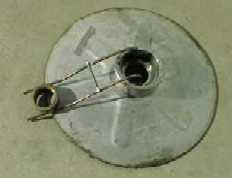
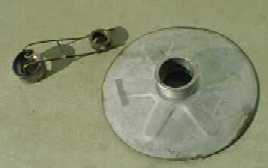
At first I had leak problems because the hole I cut into the keg was so close to the seal, it had to be centered exactly, or it leaked. Using the same seal, I cut a polycarbonate disk and placed it against the seal, added a gasket and it worked fine. Leaving a flat surface for the seal, and the keg convex top cant miss the gasket. The gasket width gave me a lot more flexibility with centering to the hole. You can see the line around the opening, the original seal locates inside the line.
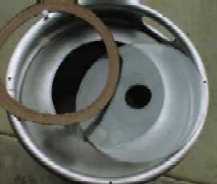
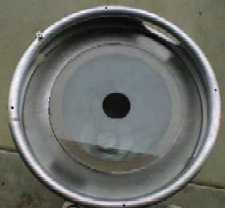
Next, I built another lid (untried as of yet) but cut a .5" wide, .075 deep grove around radius, which will center on the keg opening and filled it with RTV. It should be reusable several times, and it fits really nice. The first pix shows the 2-15 degree angles on the copper disk edge, that really helps keep the seal (black) in place. I use a brass pin in the bottom of the column to hold the packing in place, easy to remove so the polycarbonate disk can be slid on.
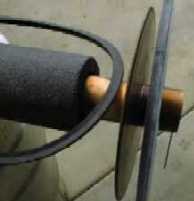
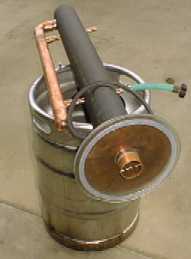
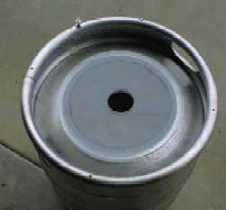
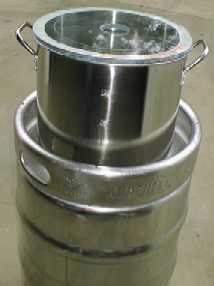
While I was making plastic circles and a big mess in the garage I cut this one to fit a stainless pot with a flat edge. I used a paper gasket, and lots of clamps to hold it down, that's how I got the mini model (see the photos page). This looks lots simpler without clamps.
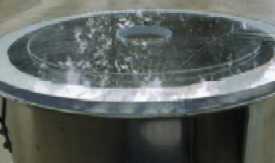
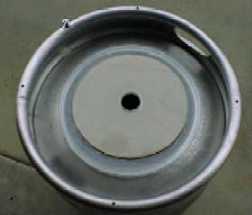
And, last but not least, (while I was continuing the mess in the garage) I made a smaller disk and put a hole in it to match a carboy. Now, the standard fermentation lock and cork will fit, and I can use the keg for a ferment container. Still working on a good wort recipe, after that I'll try this setup. The brown protective paper is still attached, that gets removed.
-
Another way to attach the column after the ball valve spear is removed is to
use a 2" tri clamp. A 2" tri clamp fits perfectly around the lip on top of
the keg fitting and clamps the column onto the keg tight. Granted its not as
easy to clean (i have a ball valve on the bottom side) but sure is easier
than building that top assemble.
Cleaning Glass
Mecakyrios writes...-
...[for] jugs and bottles that have stubborn residue in
them ..what I do is to take a length of galvanized
chain -- smaller than the diameter of the bottle opening, and longer then
the height of the bottle -- and attach to the fishing line, which in turn
is attached to a spare cork.
I used to mix a solution of baking soda and water, but now I use a product available in the States known a Oxiclean (http://www.oxiclean.com/ABOUT.HTML) and water. I pour this into the bottle and drop the chain in the bottle as well. I place my hand over the bottle opening to prevent the cleaning solution from coming out and to keep the fishing line in place (the cork is out side of the bottle -- the cork is for easy removal of the chain/fishing line). I then shake, swish, and swirl the bottle making sure to get every inside surface as best as I can. Then I remove the chain/fishing line, and pour out the cleaning solution. I then sterilize the bottle with a bleach/water solution, and store upside down until I need it.
I have found that my chain method works better -- for me -- than the gravel method that is sometimes recommended. If the bottle is still dirty after cleaning in this fashion, your best bet is to not use the bottle, as nothing will -- to my knowledge -- effectively clean the bottle.
For normal bottles and small jugs that need regular cleaning, I just use the dishwasher. What I do is invert the bottles and jugs so that their openings are toward the bottom of the dishwasher.
In my dishwasher (and I assume most have this) there are two places that you can place dishwasher detergent -- one regular "cup" that holds the detergent for regular loads, and a smaller cup to hold extra detergent for dirty loads. In my dishwasher The smaller cup empties first and then later in the cycle the regular "cup" is used.
Instead of using dishwasher detergent, I fill the smaller cup up with Oxiclean (www.oxiclean.com), and I leave the regular load "cup" empty (If you don't have Oxiclean, just leave everything empty and run the load with just water). So, what happens is when the load starts the small cup empties the Oxiclean into the wash and gives them a hot bath with Oxiclean. Then the regular cycle kicks in -- without detergent or Oxiclean -- and rinses the bottles with clean HOT water.
Pot Scourers / Scouring Pads
Make sure that your scouring pads are stainless steel or copper. Otherwise they are likely to rust. Some of the cheaper ones might be galvanised steel, and may soon break down. Stainless should be shiny whilst the galvanised is grey in appearance.If you have found a source of pot scourers/scrubbing pads, but are unsure of how they will perform, Patrick has a simple test ..
-
.. I soaked one in salt water (sea salt) and left it out in
the elements for about 2 weeks. No tarnishing or rust.
- http://www.cjms.com/easonr/scotstainste.html
- http://www.reckittprofessional.com/find_a_product/products/chore_boy.html
- http://www.cookscorner.com/